Pages

Friday, November 20, 2009

What Is So Bad About Religion?

my comments in green
source: http://www.atheistrev.com/2009/11/whats-so-bad-about-religion.html
What's So Bad About Religion? AtheistRevolution says
  • Religion is Inherently Divisive
    • labeling children as belonging to various faith traditions about which they may know little
    • segregating schools
    • taboos about marrying out of the in-group
    • [sometimes] dehumanize members of the out-group
    • [sometimes] makes the wholesale slaughter of out-group members permissible
  • Some Elements of Religious Doctrine are Directly Harmful
    • "end times" theology (has this spread to the UK?)
      • little motivation to improve one's world if one is convinced that the end is coming during one's lifetime. c.f. Humanists believe that this is the only life we have and that their is no other world after we die
        • If a politician is convinced that the end of the world is right around the corner, we cannot expect him or her to pursue policies in the long-term interest of our nation and the future generations which will inhabit it.
        • We may even be forced to imagine the same politician attempting to hasten the end through deliberately provoking wars, foreign occupations, and the like. I don't know of any politicians that really think this way - but then I don't live in the USA!
      • how many other institutions or belief systems could lead one to bring about mass destruction to hasten an afterlife? 
        • How many other institutions or belief systems could so effectively motivate the sort of suicide bombings that have become so common in Iraq?  Indeed, what is the psyche of suicide bombers?
      • the stubborn insistence that we cling to such antiquated ethical systems hinders progress in a number of important domains (e.g., human rights, gender equality, reproductive rights, slavery, stem cell research, etc.).
    • Summary
      • What is so bad about religion is that
        • it divides people and demonizes the out-group to the point where virtually any fate inflicted on them can be justified as divinely sanctioned. 
      • What is so bad about religion is that 
        • it fosters a primitive form of morality that hinders progress in virtually any domain beneficial to our modern world. 
      • What is so bad about religion is that 
        • it facilitates the commission of atrocities by good people who are merely pursuing "the divine."
    Read further arguments at Atheist Revolution

    Wednesday, November 18, 2009

    From buses to billboards: the next stage of the Atheist Bus Campaign is unveiled for Universal Children’s Day

    Billboard adverts have gone up today in London, Edinburgh, Cardiff and Belfast, as the internationally renowned poster campaign which began this year on London buses launches its second phase. So much money was donated towards the campaign after the bus posters had been launched that the campaign organisers announced that any further money raised would be put towards new adverts later in the year.

    ‘One of the issues raised again and again by donors to the campaign was the issue of children having the freedom to grow up and decide for themselves what they believe, and that we should not label children with any ideology,’ said Ariane Sherine, original creator of the Atheist Bus Campaign. ‘I hope this poster campaign will encourage the government, media and general public to see children as individuals, free to make their own choices, and accord them the liberty and respect they deserve.’

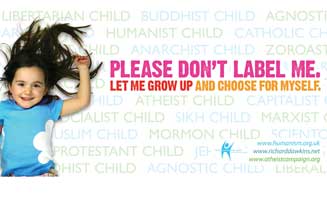
    The posters display some of the labels routinely applied to children that imply beliefs such as ‘Catholic’, ‘Protestant’, ‘Muslim’, ‘Hindu’ or ‘Sikh’ mixed up together with labels that people would never apply to young children such as ‘Marxist’, ‘Anarchist’, ‘Socialist’, ‘Libertarian’ or ‘Humanist’. In front of the shadowy labels are happy children, with the slogan, ‘Please don’t label me. Let me grow up and choose for myself’ in the now world-famous font of the Atheist Bus Campaign. The billboards are being unveiled to coincide with 20 November, Universal Children’s Day, which is the United Nations ‘day of worldwide fraternity and understanding between children’.

    ‘We urgently need to raise consciousnesses on this issue,’ said Richard Dawkins, Vice President of the BHA, President of RDFRS, and co-sponsor of the campaign. ‘Nobody would seriously describe a tiny child as a “Marxist child” or an “Anarchist child” or a “Post-modernist child”. Yet children are routinely labelled with the religion of their parents. We need to encourage people to think carefully before labelling any child too young to know their own opinions and our adverts will help to do that.’

    Andrew Copson, BHA Director of Education, said, ‘The labelling of children becomes even worse when it is implemented as a matter of public policy. One of the issues we hope to highlight with these adverts is the continuing and increasing segregation of children according to parental religion in state-funded “faith schools.” Social cohesion and preparation for life in a diverse society is best achieved in inclusive community schools, where children from different backgrounds learn with and from each other without being divided by labels that they are not old enough to have chosen for themselves.’

    The billboards will remain up for two weeks. The BHA has launched a fundraising campaign to coincide with the unveiling of the billboards which will raise money for campaigns to phase out state funded 'faith schools’.

    Notes

    Images of the billboards and FAQs


    Billboard locations:

    London: Old Street roundabout

    Cardiff: 42 Merthyr Road

    Edinburgh: Portobello Road, Piershill

    Belfast: 74-76 Great Victoria Street / Bruce Street

    The Atheist Bus Campaign’s appeal for donations to fund the bus adverts was launched in October 2008, aiming to raise just £5,500. Within four days it had raised £100,000 in individual donations from the general public and went on to raise over £153,523, smashing its original target by 2791%

    Spin-offs from the campaign have included bus and other advertising campaigns organised by humanist organisations all over the world and a book edited by Ariane Sherine, ‘The Atheist’s Guide to Christmas’, the proceeds of which are being donated to Terrence Higgins Trust.

    In 2009 Universal Children’s Day marks the twentieth anniversary of the UN Convention on the Rights of the Child and the sixtieth anniversary of the UN Declaration of the Rights of the Child.

    Articles of the Convention on the Rights of the Child include: 

    • Article 2, where the child is ‘protected against all forms of discrimination or punishment on the basis of the status, activities, expressed opinions, or beliefs of the child's parents, legal guardians, or family members’; 
    • Article 13 which provides that the child should ‘have the right to freedom of expression; this right shall include freedom to seek, receive and impart information and ideas of all kinds’; 
    • Article 14 which guarantees that states will ‘respect the right of the child to freedom of thought, conscience and religion.’

    children should have the freedom to grow up and decide for themselves what they believe.


    Atheist groups unveil latest advertising campaign

    LONDON - The consortium of atheist groups behind January's London bus campaign with the tagline "There's probably No God," unveiled today a billboard campaign to coincide with the UN's Universal Children's Day
    Atheist groups unveil latest advertising campaign

    Billboard adverts have gone up in London, Edinburgh, Cardiff and Belfast.
    The ad campaign coincides with the launch of a fundraising campaign to lobby for the phasing out of state-funded 'faith schools'.
    Ariane Sherine, original creator of the Atheist Bus Campaign, said children should have the freedom to grow up and decide for themselves what they believe.
    ‘I hope this poster campaign will encourage the government, media and general public to see children as individuals, free to make their own choices, and accord them the liberty and respect they deserve.'
    The posters display some of the labels routinely applied to children that imply beliefs such as ‘Catholic', ‘Protestant', ‘Muslim', ‘Hindu' or ‘Sikh' mixed up together with labels that people would never apply to young children such as ‘Marxist', ‘Anarchist', ‘Socialist', ‘Libertarian' or ‘Humanist'.
    In front of the shadowy labels are happy children, with the slogan, ‘Please don't label me. Let me grow up and choose for myself'.
    Richard Dawkins, vice president of the British Humanist Association HA and co-sponsor of the campaign, said.: ‘Nobody would seriously describe a tiny child as a "Marxist child" or an "Anarchist child" or a "Post-modernist child". Yet children are routinely labelled with the religion of their parents. We need to encourage people to think carefully before labelling any child too young to know their own opinions and our adverts will help to do that.'

    Tuesday, November 17, 2009

    'Faith is no reason' - Best Blasphemy Awards from Council of Secular Humanism

    source: email from Council of Secular Humanism
    Best Blasphemy Awards Announced
    Center for Inquiry declares 'Faith is no reason' the winner.


    The Center for Inquiry (CFI) is pleased to announce that Ken Peters of California is the Grand Prize winner of its Blasphemy Contest, which asked contestants to submit statements of no more than twenty words critical of religious beliefs. The entry Mr. Peters submitted was: “Faith is no reason.”


    In announcing the award, CFI president and CEO Ronald A. Lindsay said “This entry, using only four words, summarizes nicely one of the key principles of post-Enlightenment thought. Beliefs should be based on evidence and reason. Faith is not a basis for logically sound belief.”


    When CFI decided in September to hold a contest in conjunction with its commemoration of International Blasphemy Day, it generated a firestorm of controversy. Some observers claimed that CFI was soliciting hate speech, and they likened CFI to Nazis publishing anti-Semitic attacks.


    CFI rejected those mischaracterizations then and continues to reject them now. “In holding a blasphemy contest, we wished to underscore our position that religious beliefs are subject to examination and criticism, just like other beliefs,” said Lindsay. “Sometimes that criticism may take the form of a scholarly essay; sometimes the criticism may take the form of a pithy, pointed remark. Both are appropriate forms of free expression.”


    CFI emphasized it wanted clever, concise statements that might capture some of the flaws of religious beliefs. CFI was not interested in crude attacks on believers. CFI was not disappointed in the entries—either in their quality overall or their quantity. Approximately 650 contestants submitted over a thousand entries (contestants could submit two entries).


    In addition to the Grand Prize winner, there were four other winners. Their entries were:
    • “There’s no religion like no religion,” submitted by Daniel Boles of Thailand
    • “I wouldn’t even follow your god on Twitter,” submitted by Michael Hein of South Carolina
    • “The reason religious beliefs need protection from ridicule is that they are ridiculous,” submitted by Michael Nugent of Ireland
    • “I survived the God virus,” submitted by Perry Bulwer of British Columbia, Canada.
    All top five winners will receive a CFI T-shirt with their submission imprinted on the shirt. Ken Peters, the Grand Prize winner, will also receive a coffee mug with his slogan and he will be officially recognized in a forthcoming issue of Free Inquiry, the magazine published by CFI’s affiliate, the Council for Secular Humanism.


    The contest judges also decided that ten other entries, including a couple of limericks, would receive “honorable mention.” Those entries, and further information about the contest, can be found at the official announcement on CFI’s Web site.

    The Blasphemy Contest was one component of CFI’s continuing
    Campaign for Free Expression. Another ongoing contest that is also part of the Campaign is the Free Expression essay contest ($2,000 Grand Prize).


    CFI thanks everyone who took the time to submit an entry. Your participation helped make the contest a success.

    Saturday, November 14, 2009

    Michael Green: On the shoulders of Newton and Hawking


    The physicist follows Isaac Newton and Stephen Hawking into the Lucasian chair of mathematics at the University of Cambridge.
    Congratulations. How did it feel when you heard the news?
    I was very pleasantly surprised - but also overawed. This is a position that has had some extraordinary incumbents. It is loaded with a history that means I have an awful lot to live up to.
    What plans do you have for the role?
    For a long time I've been involved in the interface of elementary particle physics and general relativity, string theory in particular. Some very exciting things have been happening in string theory that I wish to pursue. Although string theory has not fulfilled or even come close to its original aims - to unify our ideas about the fundamental forces - it is now providing surprising insights in other areas of fundamental physics. These are problems that nobody has had any way of understanding and now we have a chance of solving.
    More..

    Complete World of Human Evolution

    Complete World of Human Evolution by Chris Stringer and Peter Andrews.

    Buy the book at the Natural History Museum bookshop or Amazon.