I quoted Carl Sagan (from 2 minutes) at last Dorset SACRE meeting.

Showing posts with label Carl Sagan. Show all posts
Showing posts with label Carl Sagan. Show all posts
Friday, July 02, 2010

Tuesday, October 20, 2009
Cosmos Remixed
source: http://www.lbi.co.uk/blog/scienceartemotion/

This work by crabsallover is licensed under a Creative Commons Attribution-Non-Commercial-Share Alike 2.0 UK: England & Wales License.
HASSNERS.org highlights
HASSNERS.org comments
This work by crabsallover is licensed under a Creative Commons Attribution-Non-Commercial-Share Alike 2.0 UK: England & Wales License.
Monday, August 31, 2009
The Atheist & The Bishop, part 2
source: http://www.bbc.co.uk/programmes/b00m1nm2 via http://richarddawkins.net/article,4237,n,n
This work by crabsallover is licensed under a Creative Commons Attribution-Non-Commercial-Share Alike 2.0 UK: England & Wales License.
iPlayer audio available to 6 September.
2/3. Professor AC Grayling and Lord Harries of Pentregarth explore where we get our values from
Series in which an atheist and a bishop come together to apply their own philosophies to the experiences of people they meet, with Jane Little chairing the discussion
HASSNERS.org highlights
HASSNERS.org comments: visit Bacons College, London & Camp Quest, Somerset. At the faith school, AC Grayling wonders if having a faith orientation adds anything and whether it effects intellectual enquiry.
Faith
AC Grayling: (5'40" to 6' 4") Faith comes down in the end to saying 'blessed are the those who believe but havn't seen, that is to say, don't have evidence or who havn't got a reason for believing; how is this consistent with one of the great aims of education which is to equip students with an ability to evaluate information, to think critically, to assess evidence and to think for themselves.
Parental Indoctrination
AC Grayling (16'20' -16'28") to a muslim student "would you be a muslim if you had been born to two very devout Roman Catholic parents?" Muslim Student: "I doubt it, I'd probably be Roman Catholic".
Logical Fallacies
Samantha Stein (24'30') talks about introducing children to logical fallacies (informal fallacy) and Straw Man arguements.
Extraordinary Claims require Extraordinary Evidence (Carl Sagan)
AC Grayling (25' 26") to Samantha Stein: " how will you encourage children to have a clear idea of what they think and a clear idea of what viewpoints don't deserve respect if they don't?"
SS: she will ask children to invoke Carl Sagan phrase 'extraordinary claims require extraordinary evidence'. Anything they are faced with, be it scientology, religion, homeopathy - anything that requires that if someone is making claims for which you need to believe in something, you cannot see or cannot be empircally tested, then, they need to consider Carl Sagans' phrase.
SS: she will ask children to invoke Carl Sagan phrase 'extraordinary claims require extraordinary evidence'. Anything they are faced with, be it scientology, religion, homeopathy - anything that requires that if someone is making claims for which you need to believe in something, you cannot see or cannot be empircally tested, then, they need to consider Carl Sagans' phrase.
AC Grayling (28') asks 'Suppose a martian came down to earth, was presented with two docuements, the New Testament and The Koran, how would the martian choose between those two documents to find which was true and which was not true?" A Muslim Physics teacher responds.
AC Grayling: (36' 40") is asked 'where do humanistic values come from? we are social animals capable of empathy... basis of our thinking about morality and organisation of society... he talks about Aristotle & happiness and evolutionary psychology... many talents for being good.
This work by crabsallover is licensed under a Creative Commons Attribution-Non-Commercial-Share Alike 2.0 UK: England & Wales License.
Thursday, July 02, 2009
The Baloney Detection Kit (or Scientific Method Made Simple!)
As Carl Sagan said "There is a lot of baloney out there". What is the Baloney Detection Kit? It's the scientific method.. or just science!Credit to Carl Sagan who originally developed the Baloney Detection Kit in his book 'The Demon Haunted World".
Over 300 comments on RichardDawkins.net
source: http://www.michaelshermer.com/2009/06/baloney-detection-kit/
source: http://www.michaelshermer.com/2009/06/baloney-detection-kit/
The Baloney Detection Kit (on RDF TV)
With a sea of information coming at us from all directions, how do we sift out the misinformation and bogus claims, and get to the truth? Michael Shermer, Publisher ofSkeptic magazine, lays out a “Baloney Detection Kit” — ten questions we should ask when encountering a claim.
With a sea of information coming at us from all directions, how do we sift out the misinformation and bogus claims, and get to the truth? Michael Shermer, Publisher ofSkeptic magazine, lays out a “Baloney Detection Kit” — ten questions we should ask when encountering a claim.
THE TEN QUESTIONS
- How reliable is the source of the claim?
- Does the source make similar claims?
- Have the claims been verified by somebody else?
- Does this fit with the way the world works?
- Has anyone tried to disprove the claim?
- Where does the preponderance of evidence point?
- Is the claimant playing by the rules of science?
- Is the claimant providing positive evidence?
- Does the new theory account for as many phenomena as the old theory?
- Are personal beliefs driving the claim?
CREDITS
This is the first video by RDFTV.
Presented by The Richard Dawkins Foundation for Reason and Science
Directed by Josh Timonen
Copyright © 2009 Upper Branch Productions, Inc.
Presented by The Richard Dawkins Foundation for Reason and Science
Directed by Josh Timonen
Copyright © 2009 Upper Branch Productions, Inc.
Wednesday, June 25, 2008
An Interview with Prof. Richard Dawkins
by Nicholas Newman, Oxford Prospect
Interviewed by Nicholas Newman at Dawkins' Oxford home 24 June 2008
Reposted from:
http://www.oxfordprospect.co.uk/richarddawkins.htm
Richard Dawkins is the well known advocate of atheism and rationalism and for his criticism of religion. He holds the Chair for the Public Understanding of Science at Oxford University. I interviewed Richard Dawkins at his Oxford home recently.
Nicholas Newman
As a life long atheist, I find myself almost entirely in agreement with the views expressed in your writings, but nevertheless, it is still possible to see the utility of certain physiological aspects in some religious beliefs or customs. I'm thinking of: Comfort to a soldier about to die, or succour for a mother on the death of her child or belief in the after life of a husband who is mourning the death of his wife? Such comfort or succour would be called upon particularly in cases where no human aid would be available?
Richard Dawkins
Yes, I do see psychological value, if it does have a real value, and I would not wish to be the person who destroys that person's psychological succour. But I would not, however, compromise with my public speaking out in the public forum and writing, but if I was visiting someone who was recently bereaved, I might dissemble somewhat in what I said, but would not do so in when writing a newspaper article.
Nicholas Newman
Cannot religion, however misguided, also provide a useful social mechanism, irrespective of people's beliefs by reinforcing social discipline by using the power of religious sin to gain reinforce adherence to man made laws? E.g. Thou shall not kill? Of course such beliefs have, throughout history, been used by rulers to enforce their particular forms of governance, or lack of governance.
Richard Dawkins
Yes, the first thing I say about that is that
Nicholas Newman
Oh you mean when police officers staged a 16-hour strike in Montreal, which led to a wave of rioting and looting, which was only ended when the army was brought in, because nobody had anything to fear from the Police?
Richard Dawkins
So you might say if God was suddenly abolished, it would be like a police strike; people would go on a rampage of immorality. Yet, it does make me wonder how sincere many of these rioters were; I suspect many would say they were religious. It looks like the real flesh and blood Police acted as a real deterrent. I find that impressive, as a Darwinian I think many of us, do have a built in morality, just like we have sexual desire built into us, from our Darwinian past, we do feel a sense of justice, fairness, empathy and sympathy for people in trouble or suffering.
These are all very powerful emotions, which I am almost sure have nothing to do with religion. Like the grief you feel vicariously when consoling someone who is bereaved or the sense of monstrous injustice one feels for a person who has been framed for a crime that he did not commit. These are all emotions that a naive interpretation that humans are selfish should not be expected and yet it is there, in all of us, whether or not we are religious.
Nicholas Newman
I was asking about the role of religion in reinforcing the laws of society. In respect of your answer it is hard to draw such conclusions from such a short event which took place against a background of serious industrial disputes prior to the Montreal police strike. Surely such rioting would not have continued indefinitely, before the population would have restored order, to ensure the continuation of civil life?
Turning to the next question.
Richard Dawkins
I am not sure that this is true today. For me the great watershed would have come with Darwin and I am utterly unmoved by the fact that Newton was religious. Anyone living before Darwin, one might expect to be religious. As for today,
Einstein liked to use the word of God to explain his reverence, while I don't. I think today to use God in this sense is confusing, but was less confusing in Einstein's time. But nevertheless, there are a few scientists who are full blown religious in their beliefs and believe in the sense of the Trinity, transubstantiation etc, and I think they are rather few. I think such scientists are an anomaly, I think it must be possible for the human mind to compartmentalize in a way I would find difficult in my head. Though, if I really try, I suspect I would find other ways of compartmentalizing such idea in my brain.
Nicholas Newman
I could not agree more. Though, when I recently interviewed Bjorn Lomborg, Bjorn accepts the reality of climate change, but he questions the proposals put forward by environmentalists with a scientific background, who put forward their solutions as if they were religious dogma, and thereby not subject to vigorous scientific analysis.
At your recent talk at the Oxford Literary Festival,
Richard Dawkins
I fully agree there are such people, though I am not sure that the popularity of pseudo science like homeopathy and UFO's can be blamed on them. Are those people interested in pseudo science really influenced by the influential people and writers who dominate the media?
Nicholas Newman
I was thinking of people like Prince Charles, as an exponent of homeopathy for instance.
Richard Dawkins
I certainly believe that if those people who love pseudo science needed an intellectual justification they could find it amongst the literati. Though, I am not sure, but they no doubt foster a kind of climate where such opinion is favoured, and where your opinion is as good as mine. Where questioning of pseudo science is frowned upon.
Nicholas Newman
Why are there so few good communicators of science like you, Jacob Bronowski, Bjorn Lomborg, Carl Sagan and Peter Atkins who have the gift to express clearly the joys of science?
Richard Dawkins
I love there to be more – there are more probably – but many don't bother to leave the comfort of their labatories to express themselves. I wish more would. Perhaps we should think of an inducement to do so. Perhaps the scientific culture should value those who express themselves to lay people.
Nicholas Newman
The trouble is science, unlike the media, has not attracted the people to join the scientific world that are clever persuasive communicators?
Your wife has played an important role in your academic life?
Richard Dawkins
Yes, my wife, Lalla Ward does play an important part in my work. She participates in the production of audio books, and the public talks I give about my work, in fact we act as a double act. I think the audiences like the double act, at least it prevents them going to sleep. She has taught me how to speak in public, read out aloud, and talks to the public. At home she acts as a copy editor who proof reads my work, checks when I repeat myself and makes it a more readable read.
Nicholas Newman
And finally. What is your next book about?
Richard Dawkins
It will be about the evidence for evolution.
Reposted from:
http://www.oxfordprospect.co.uk/richarddawkins.htm
Richard Dawkins is the well known advocate of atheism and rationalism and for his criticism of religion. He holds the Chair for the Public Understanding of Science at Oxford University. I interviewed Richard Dawkins at his Oxford home recently.
Nicholas Newman
As a life long atheist, I find myself almost entirely in agreement with the views expressed in your writings, but nevertheless, it is still possible to see the utility of certain physiological aspects in some religious beliefs or customs. I'm thinking of: Comfort to a soldier about to die, or succour for a mother on the death of her child or belief in the after life of a husband who is mourning the death of his wife? Such comfort or succour would be called upon particularly in cases where no human aid would be available?
Richard Dawkins
Yes, I do see psychological value, if it does have a real value, and I would not wish to be the person who destroys that person's psychological succour. But I would not, however, compromise with my public speaking out in the public forum and writing, but if I was visiting someone who was recently bereaved, I might dissemble somewhat in what I said, but would not do so in when writing a newspaper article.
It is also I think disputable whether it is that comforting, given that people are brought up to fear hell for example.They might actually be comforted by the lack of religion, depending on their upbringing. Although many of us fear death, I think there is something illogical about it.
As Mark Twain once said "I was dead before I was born without the slightest inconvenience."
Nicholas Newman
Cannot religion, however misguided, also provide a useful social mechanism, irrespective of people's beliefs by reinforcing social discipline by using the power of religious sin to gain reinforce adherence to man made laws? E.g. Thou shall not kill? Of course such beliefs have, throughout history, been used by rulers to enforce their particular forms of governance, or lack of governance.
The best example of this aspect has, perhaps been emperors, kings, and popes claiming they have been appointed by a god?
Richard Dawkins
Yes, the first thing I say about that is that
the religious carrot or stick argument for being good i.e. god will punish you, or reward you, is not a very, in fact, is an ignoble reason for being good.A moral philosopher could write down a better set of reasons for being good. Being cynical, one could say, people need the carrot and the stick to be good. I told – retold in my book 'The God Delusion' the anecdote by Steven Pinker, when, in 1969, police went on strike in Montreal.
Nicholas Newman
Oh you mean when police officers staged a 16-hour strike in Montreal, which led to a wave of rioting and looting, which was only ended when the army was brought in, because nobody had anything to fear from the Police?
Richard Dawkins
So you might say if God was suddenly abolished, it would be like a police strike; people would go on a rampage of immorality. Yet, it does make me wonder how sincere many of these rioters were; I suspect many would say they were religious. It looks like the real flesh and blood Police acted as a real deterrent. I find that impressive, as a Darwinian I think many of us, do have a built in morality, just like we have sexual desire built into us, from our Darwinian past, we do feel a sense of justice, fairness, empathy and sympathy for people in trouble or suffering.
These are all very powerful emotions, which I am almost sure have nothing to do with religion. Like the grief you feel vicariously when consoling someone who is bereaved or the sense of monstrous injustice one feels for a person who has been framed for a crime that he did not commit. These are all emotions that a naive interpretation that humans are selfish should not be expected and yet it is there, in all of us, whether or not we are religious.
Nicholas Newman
I was asking about the role of religion in reinforcing the laws of society. In respect of your answer it is hard to draw such conclusions from such a short event which took place against a background of serious industrial disputes prior to the Montreal police strike. Surely such rioting would not have continued indefinitely, before the population would have restored order, to ensure the continuation of civil life?
Turning to the next question.
Do you not find it ironic, that many great scientists, well versed in the 'scientific method' still find it possible to maintain their religious beliefs?
Richard Dawkins
I am not sure that this is true today. For me the great watershed would have come with Darwin and I am utterly unmoved by the fact that Newton was religious. Anyone living before Darwin, one might expect to be religious. As for today,
if you find a great scientist who is religious, cross question him and ask if he actually believes in a supernatural intelligence that listens to your prayers and reads your thoughts and forgives your sins. Or whether he is like Einstein, who believed in using quasi religious language to express his feelings for his reverence for the wonders and mysteries of the universe.
Einstein liked to use the word of God to explain his reverence, while I don't. I think today to use God in this sense is confusing, but was less confusing in Einstein's time. But nevertheless, there are a few scientists who are full blown religious in their beliefs and believe in the sense of the Trinity, transubstantiation etc, and I think they are rather few. I think such scientists are an anomaly, I think it must be possible for the human mind to compartmentalize in a way I would find difficult in my head. Though, if I really try, I suspect I would find other ways of compartmentalizing such idea in my brain.
Nicholas Newman
I could not agree more. Though, when I recently interviewed Bjorn Lomborg, Bjorn accepts the reality of climate change, but he questions the proposals put forward by environmentalists with a scientific background, who put forward their solutions as if they were religious dogma, and thereby not subject to vigorous scientific analysis.
At your recent talk at the Oxford Literary Festival,
you expressed your sorrow at the popularity of pseudo science at the expense of real science. Would you not agree that much of the blame can be laid at the influential people and writers who dominate the media, and seem even proud that they can boast that they are ignorant of science?
Richard Dawkins
I fully agree there are such people, though I am not sure that the popularity of pseudo science like homeopathy and UFO's can be blamed on them. Are those people interested in pseudo science really influenced by the influential people and writers who dominate the media?
Nicholas Newman
I was thinking of people like Prince Charles, as an exponent of homeopathy for instance.
Richard Dawkins
I certainly believe that if those people who love pseudo science needed an intellectual justification they could find it amongst the literati. Though, I am not sure, but they no doubt foster a kind of climate where such opinion is favoured, and where your opinion is as good as mine. Where questioning of pseudo science is frowned upon.
Nicholas Newman
Why are there so few good communicators of science like you, Jacob Bronowski, Bjorn Lomborg, Carl Sagan and Peter Atkins who have the gift to express clearly the joys of science?
Richard Dawkins
I love there to be more – there are more probably – but many don't bother to leave the comfort of their labatories to express themselves. I wish more would. Perhaps we should think of an inducement to do so. Perhaps the scientific culture should value those who express themselves to lay people.
Nicholas Newman
The trouble is science, unlike the media, has not attracted the people to join the scientific world that are clever persuasive communicators?
Your wife has played an important role in your academic life?
Richard Dawkins
Yes, my wife, Lalla Ward does play an important part in my work. She participates in the production of audio books, and the public talks I give about my work, in fact we act as a double act. I think the audiences like the double act, at least it prevents them going to sleep. She has taught me how to speak in public, read out aloud, and talks to the public. At home she acts as a copy editor who proof reads my work, checks when I repeat myself and makes it a more readable read.
Nicholas Newman
And finally. What is your next book about?
Richard Dawkins
It will be about the evidence for evolution.
Sunday, May 04, 2008
the total number of stars in the universe is greater than all the grains of sand on all the beaches of the planet Earth. (Carl Sagan). Correct?
I use a rule of thumb that the total number of galaxies in the universe as 100 billion (10 power 11) and the average number of stars in each galaxy as 100 billion. Total number of stars in the Universe (10 power of 22 or 1 with 22 zeros following it) or 10,000,000,000,000,000,000,000. This is similar to the figure that Glen Mackie calculates (just 5 times that number!).
Link via http://en.wikipedia.org/wiki/Galaxy#cite_note-6 (accessed 4th May 2008).
Link via http://en.wikipedia.org/wiki/Galaxy#cite_note-6 (accessed 4th May 2008).
To see the Universe in a Grain of Taranaki Sand
Glen Mackie
[appeared in North and South magazine, May, 1999]It had worried me for a long time. I could hear his voice,
... the total number of stars in the universe is greater than all the grains of sand on all the beaches of the planet Earth.
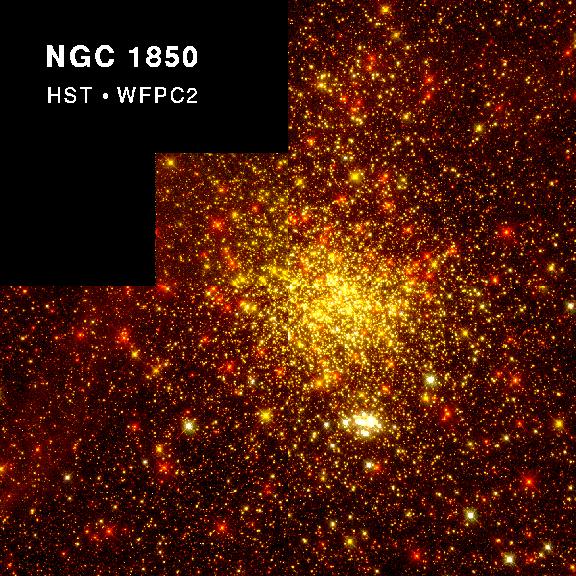
 I heard Carl Sagan repeating those words again recently when I looked along a surf beach on the Taranaki coast. Later that evening I looked up at the sky. We are fooled somewhat. Our eyes can only resolve about 5000 of the brightest stars, mostly close to our Sun, and typically within 1000 light years (1 light year is the distance light, travelling with a velocity of 300,000 kilometres per second, covers in 1 year).
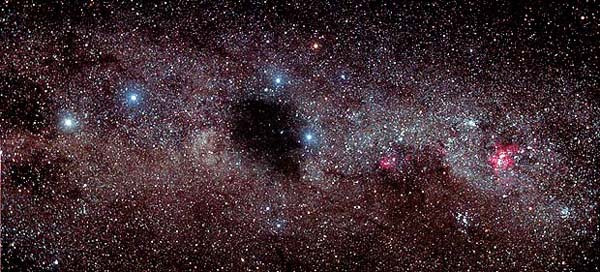 Our Galaxy however, is probably greater than 100,000 light years in diameter. Hence we can resolve only a very small fraction of our Galaxy with our eyes. As well, whilst our view of the brightest stars is a magnificent panorama we do not get any sense of depth or relative distances of stars. For example, the two bright stars close together, alpha and beta Centauri, (commonly called The Pointers because they guide us to the nearby Southern Cross) are at very different distances. Rigil Kentaurus and Hadar (their common names) are 4.3 and 490 light years distant, respectively. Hardly neighbours!
The faint smudge of light we call the Milky Way, easily visible on a dark night, is millions of very faint, distant stars lying in the disk of our Galaxy that our eyes cannot resolve. Dark clouds of dust (microscopic pieces of carbon and silicon) dimms the light of many more stars. Apart from a few neighbouring galaxies (including the Large and Small Magellanic Clouds visible in the southern sky), that appear as faint, fuzzy blobs of light, our naked eye perception of the universe is very myopic.
My feet stood on what seemed to be an unfathomable number of sand grains on that wide, long Taranaki beach. If sand grains were stars, a handful of sand thrown into an empty sky could easily replicate what we see. Imagine the brilliant sky you could create with a whole beach of sand! The voice returned. Carl was probably right. He would have done the calculation. Doubts remained though, and I knew it was time to put his voice to rest.
I knew some average numbers for stars and galaxies. In many astronomical studies an answer to within an order of magnitude (a factor of 10) is deemed acceptable. Since I had a funny feeling that an average beach may also be hard to describe, I decided to accept order of magnitude accuracy.
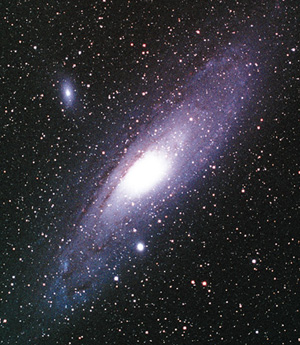
Our Galaxy, has approximately 400 billion stars. Carl used this number in the book based on his Cosmos television series and I'll stick with it.We define a billion as 10 to the power 9, or 1 with 9 zeroes following it, ie. 1,000,000,000. Big. Is our Galaxy average? Well, it's a spiral, a little less massive than our magnificent Local Group neighbour, Messier 31 in Andromeda. As far as spirals go, it's probably close enough to average. The other galaxies that exist in the universe, large ellipticals and smaller irregular galaxies, tend to have more and less stars, respectively. I'll assume that, in terms of star numbers, our Galaxy represents the average galaxy.
What is the total number of galaxies in the universe?
Sagan assumed 100 billion.Is that still valid? Recently the Hubble Space Telescope (HST) surveyed, to the faintest levels yet detected, a small area of sky. Extrapolating from the number of galaxies detected by HST to that expected over the whole sky, I calculate 130 billion galaxies, slightly larger than Sagans estimate.
Then the number of stars in the universe is 400 billion x 130 billion, or about 50,000 billion billion. A billion billion. That's 1,000,000,000,000,000,000. So, grasp the concept of a billion billion, then think of 50 thousand of those. Easy! - 50,000,000,000,000,000,000,000.
What are the dimensions of an average, sandy beach on Earth? I was lucky. I know a Coastal Geomorphologist (doesn't everyone?) who provided some estimates. Take 360,000 kilometres of coast (the total coastline of the world is about 1 million kilometres, of which about 36 percent is sandy), mix with an average beach width of 50 metres (high to low tide lines), and add a dash of average beach depth of 4 metres.
The diameters of sand grains range from about 0.1 to 2 millimetres. We'll adopt an average diameter of 0.5 millimetres. Lets stack them simply, one on top of another (not very likely in a beach I admit), so that 8000 fit into 1 cubic centimetre. Drum roll please. The total number of sand grains on our Earth beach is then 600 billion billion. But wait!, I hear some of you remarking about sand dunes and sand below the low tide mark. To placate you worriers I'm happy to increase my initial estimate by a factor of 3. That gives me a grand total of about 2000 billion billion grains of sand on Earth.
The stars win! Carl was right, ... maybe. The excess factor (the number of stars divided by the number of grains) of 50,000/2000 or 25 is greater than an order of magnitude, but only just. My individual assumptions must be wrong at some level. Maybe the average galaxy has only 40 billion stars (faint surveys do detect many small, ``dwarf'' galaxies). As well, maybe the number of sand grains is three times greater. (In fact my Coastal Geomorphologist suggested that the average grain diameter could be smaller than 0.5 millimetres, probably allowing us to stack a factor of 3 more!). Combine these two changes and the grains win, just!
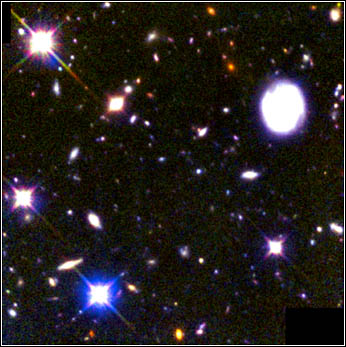
Not so fast! Any (conspired) increase in the number of sand grains is probably offset by the recent discovery of many more galaxies by HST in the near-infrared region of the electromagnetic spectrum, not previously detected in optical surveys. Observing in the infrared minimizes the absorbing effects of dust allowing us to see galaxies enshrouded in large amounts of dust present because of vigorous star formation. The odds are that there are many more than 130 billion galaxies in the universe. I'll cast my final vote in favour of the stars, and I'll admit a slight astronomical bias (see author notes).
I returned home after three days of travelling. I could now stand on a beach and not hear Carl Sagans voice. I had even warmed to the number billion. For example, whilst I was away during those three days, our Galaxy had moved another 0.2 billion kilometres towards the Virgo cluster of galaxies (located 650 billion billion kilometres away), and the population of New Zealand had experienced 1,600 billion heartbeats. Now, is that resting heartbeat? Here we go again.
Carl Sagan (1934-1996) was Director of the Laboratory for Planetary Studies and David Duncan Professor of Astronomy and Space Sciences at Cornell University. Professor Sagan was a leading popularizer of science and astronomy in particular, and presented the Cosmos television series and wrote the book (Cosmos, Random House: New York) based on the series.
Glen Mackie is Lecturer, in the Centre for Astrophysics and Supercomputing, Swinburne University of Technology, Melbourne, Australia.
Last updated February 1, 2002
Wednesday, February 06, 2008
Quotes
Here's a few quotes I picked up:
“Whenever we read the obscene stories, the voluptuous debaucheries, the cruel and torturous executions, the unrelenting vindictiveness, with which more than half the Bible is filled, it would be more consistent that we called it the word of a demon, than the word of God. It is a history of wickedness, that has served to corrupt and brutalise mankind.” (Thomas Paine: The Age of Reason)
“Life is but a momentary glimpse of the wonder of this astonishing universe, and it is sad to see so many dreaming it away on spiritual fantasy.” Carl Sagan
“That man is the product of causes which had no pre-vision of the end they were achieving; that his origin, his hopes and fears, his loves and beliefs are but the outcome of accidental collocations of atoms; that no fire, no heroism, no intensity of thought and feeling, can preserve an individual life beyond the grave; that all the labours of the ages, all the devotion, all the inspiration, all the noonday brightness of human genius, are destined to extinction in the vast death of the solar system, and that the whole temple of man’s achievement must inevitably be buried beneath the debris of a universe in ruins – all these things, if not quite beyond dispute, are yet so nearly certain that no philosophy which rejects them can hope to stand. Only within the scaffolding of these truths, only on the firm foundation of unyielding despair, can the soul’s habitation henceforth be safely built.” Bertrand Russell
Phil
Wednesday, December 19, 2007
SETI Requires a Skeptical Reappraisal
reposted from: http://www.csicop.org/si/2006-03/seti.html
Chris Street comments are in bright green;
Chris Street comments are in bright green;
highlights in yellow blockquotes.
Early SETI efforts were marked by overly optimistic estimates of the probable number of extraterrestrial civilizations in our galaxy. In light of new findings and insights, it seems appropriate to put excessive euphoria to rest and to take a more down-to-earth view.
Earth may be more special, and intelligence much rarer, in the universe than previously thought.
 The possible existence of extraterrestrial intelligence (ETI) has always stirred the imagination of man. Greek philosophers speculated about it. Giordano Bruno was burnt on the stake in Rome in 1600, mainly because positing the likelihood of other inhabited worlds in the universe. Kant and Laplace were also convinced of the multiplicity of worlds similar to ours. In the latter part of the nineteenth-century Flammarion charmed vast circles with his books on the plurality of habitable worlds. But all these ideas were mainly philosophical considerations or pure speculations.
It was only in the second half of the twentieth- century that the Search for Extraterrestrial Intelligence (SETI) became a scientifically underpinned endeavor.Since the late 1950s distinguished scientists have conducted research, attempting to receive intelligent signals or messages from space via radio-telescopes. Hundreds of amateur astronomers, members of the SETI-League in dozens of countries, are scanning the sky, trying to detect evidence of intelligent life elsewhere in our galaxy. SETI pioneers, such as Frank Drake and Carl Sagan, held the stance that the Milky Way is teeming with a large number of advanced civilizations. However,
the many search projects to date have not succeeded, and this daring prediction remains unverified.New scientific insights suggest the need for a more cautious approach and a revision of the overly optimistic considerations.
The standard
argument for the existence of a multiplicity of intelligent life runs like this:There are
about 200 to 300 billion stars in our galaxy and probably hundreds of millions, maybe even billions of planets in our galaxy.
Many of these planets are likely to be located in the so-called "habitable zone" in relation with their star, enjoying-as Earth-favorable conditions for the evolution of life. The physical laws, known to us, apply also to the cosmos, and far-away stellar formations are composed of the same elements as our solar system. Therefore, it is assumed, many should possess water and a stable atmosphere, considered to be basic requisites for the development of life. Such planets must have experienced geological and biological processes similar to those on Earth, leading to the development of primitive life organisms. Then, in the course of time, following a similar course of Darwin's theory of natural selection, these evolved into more complex forms, some eventually developing cognitive capacities and-as in our case-higher intelligence.
In other words, it is maintained,
our solar system, Earth, and its evolution are not exceptional cases, but something very common in our Milky Way galaxy. Consequently it must be populated by a huge number of extraterrestrial civilizations, many of them older and more advanced than ours.
Considering the enormous number of stars and planets, these seem like fair and legitimate assumptions. It indeed appears unlikely that intelligence should have evolved only on our planet. If many of these civilizations are scientifically and technologically superior to us, contact with them would give mankind a boost in many ways.
These optimistic views are based mainly on the famous Drake formula N=RfpnefifjfeL. It considers the formation of stars in the galaxy, the fraction of stars with planetary systems, the number of planets ecologically suited for life, the fraction of these planets, on which life and intelligent life evolves, and those reaching a communicative stage and the length of time of technical civilizations.
On the basis of this formula it was estimated that a million advanced civilizations probably exist in the galaxy.
The nearest one should be at a distance of about 200 to 300 light-years from Earth.German astronomer Sebastian von Hoerner estimated a number between ten thousand and ten million such civilizations.
But
because of many new insights and results of research in a number of scientific fields, ranging from paleontology, geology, biology to astronomy, I believe this formula is incomplete and must be revised. The early optimistic estimates are no longer tenable. A more realistic and sober view is required.
I by no means intend to discredit SETI; the search for extraterrestrial intelligent life is a legitimate scientific endeavor. But it seems prudent to demystify this interesting subject, and to reformulate its claims on a new level, free of the romantic flair that adorns it.
Years ago, I readily admit, I myself was quite taken in by the allegations that intelligence is a very common phenomenon in the galaxy. In books, articles, and on radio and television I advocated the idea that our world, beset by problems, could learn a lot from a civilization more advanced than ours. But, in the meantime, I became convinced that a more skeptical attitude would do reality better justice.
There are probably only a few such civilizations in the galaxy, if any at all.The following considerations buttress this rather pessimistic appraisal.
First of all, since project OZMA I in 1959 by Frank Drake, about a hundred radio-magnetic and other searches were conducted in the U.S. and in other countries, and a considerable part of our sky was scanned thoroughly and repeatedly, but it remained disappointingly silent. In forty-six years not a single artificial intelligent signal or message from outer space was received. Some specialists try to downplay this negative result, arguing that so far only a small part of the entire spectrum has been covered, and that more time and more sophisticated equipment is required for arriving at a definite conclusion. Technological and economic criteria may thwart the possibility of extraterrestrial civilizations beaming signals into space over long stretches of time, without knowing where to direct their signals. Or, they may use communication methods unknown to us. Another explanation is that advanced ETI may lack interest in contacting other intelligences, especially those less developed. The argument of the Russian rocket expert Konstantin Tsiolkovski is often quoted:
"Absence of evidence is not evidence of absence."
But neither of these arguments, which attempt to explain why we have not received a single intelligent signal from space-is convincing. True, future search projects may strike pay dirt and register the reception of a signal of verified artificial origin. But as long as no such evidence is forthcoming, the possibility of achieving success must be considered remote. If a hundred searches were unsuccessful, it is fair to deduce that estimates of a million or many thousands ETI are unsustainable propositions.
As long as no breakthrough occurs, the probability of contact with ETI is near to zero.The argument that advanced extraterrestrials may not be interested in contact with other intelligences is also-as I will show-highly implausible.
Second, as recent research results demonstrate, many more factors and conditions than those considered by the Drake formula need to be taken into account. The geologist Peter D. Ward and the astronomer Donald Brownlee present in their book Rare Earth a series of such aspects, which turn the optimistic estimates of ETI upside down.
According to their reasoning, the old assumption that our solar system and Earth are quite common phenomena in the galaxy needs profound revision. On the contrary, the new insights suggest, we are much more special than thought. The evolution of life forms and eventually of intelligent life on Earth was due to a large number of very special conditions and developments, many of a coincidental nature. I'll mention only some that seem particularly important: The age, size, and composition of our sun, the location of Earth and inclination of its axis to it, the existence of water, a stable oxygen-rich atmosphere and temperature over long periods of time-factors considered essential for the evolution of life-and the development of a carbon-based chemistry. Furthermore an active interior and the existence of plate tectonics form the majestic mountain ridges like the Alps, the Himalayas and the Andes, creating different ecological conditions, propitious for the proliferation of a great variety of species. Also the existence of the Moon, Jupiter, and Saturn (as shields for the bombardment of comets and meteorites during the early stages of Earth). Also the repeated climatic changes, long ice ages, and especially the numerous and quite fortuitous catastrophes, causing the extinction of many species, like the one 65 millions years ago, which led to the disappearance of dinosaurs, but opened the way for more diversified and complex life forms.
Though first primitive life forms on Earth, the prokaryotic bacteria, evolved relatively rapidly, only about 500 million years after the cooling off of Earth's crust and the end of the dense bombardment of meteorites and comets, they were the only lifeforms during the first two billion years of Earth's 4.6-billion-year history. Mammals-including apes and man-developed much later, only after the extinction of the dinosaurs 65 million years ago. The first human-like being, the Proconsul, emerged in the Miocene Period, just about 18 million years ago. The Australopithecus, our antecessor, dates only 5 to 6 million years. In other words,
it took almost 4 billion years, or more than 96 percent of the age of Earth, for intelligence to evolve-an awfully long time, even on the cosmic clock.
In this regard we should note also the caveat of the distinguished biologist Ernst Mayr, who underscored the enormous complexity of human DNA and RNA and their functions for the production of proteins, the basic building blocks of life. He estimated that the likelihood that similar biological developments may have occurred elsewhere in the universe was nil.
The upshot of these considerations is the following: Because of the very special geological, biological, and other conditions which propitiated the evolution of life and intelligence on Earth, similar developments in our galaxy are probably very rare.
Primitive life forms, Ward and Brownlee conclude, may exist on planets of other stellar systems, but intelligent life, as ours, is probably very rare, if it exists at all.
Third is the so called "Fermi Paradox" another powerful reason suggesting a skeptical evaluation of the multiplicity of intelligence in the galaxy. Italian physicist Enrico Fermi posed the annoying question, "If so many highly developed ETIs are out there, as SETI specialists claim, why haven't they contacted us?" I already expressed great doubt about some of the explanations given to this paradox. Here I need to focus on two more. The first refers to the supposed lack of interest of advanced aliens to establish contact with other intelligent beings. This argument seems to me particularly untrustworthy. I refer to a Norwegian book, which explains why the Vikings undertook dangerous voyages to far-away coasts in precarious vessels. "One reason," it says, "is fame, another curiosity, and a third, gain!" If the Vikings, driven by the desire to discover the unknown, reached America a thousand years ago with a primitive technology, if we-furthermore-a still scientifically and technically young civilization, search for primitive life on other planets of the solar system and their moons, it is incredible that higher developed extraterrestrial intelligences would not be spurred by likewise interests and yearnings. One of the fundamental traits of intelligence is its unquenchable intellectual curiosity and urge to penetrate the unknown. Elder civilizations, our peers in every respect, must be imbued by the same daring and scrutinizing spirit, because if they are not, they could not have achieved their advanced standards.
A second argument often posited is that distances between stars are too great for interstellar travel. But this explanation also stands on shaky ground. Even our scientifically and technically adolescent civilization is exploring space and sending probes-the Voyager crafts-which someday may reach other stellar systems. We are still far from achieving velocities, near the velocity of light, necessary for interstellar travel. But some scientists predict that in 200 or 300 years, maybe even earlier, we are likely to master low "c" velocities, and once we reach them our civilization will send manned exploratory expeditions to the nearest stars. Automatic unmanned craft may be the initial attempts. But I am convinced that nothing will impede the desire of man to see other worlds with his own eyes, to touch their soil and to perform research that unmanned probes would not be able to perform. Evidently,
civilizations tens of thousands or millions of years in our advance will have reached near c velocities, and they will be able to explore a considerable part of the galaxy.Advanced ETI civilizations would engage in such explorations not only out of scientific curiosity, but in their own interest, for instance for spreading out and finding new habitats for their growing population, or because of the need to abandon their planet due to hazards from their star, and also because with the help of other civilizations it may confront dangers, lurking in the universe, more successfully than alone. The Fermi Paradox should therefore put us on guard, and foster a sound skepticism. Lack of interest in meeting a civilization such as ours is the least plausible reason why we have not heard from ETI.
A little mental experiment illustrates this point. Carl Sagan held once that intelligent aliens would visit Earth at least once every thousand years. But such visits have not taken place. Even extending this period to a million years, we fare no better. Let us assume an extraterrestrial craft landed on Earth any time during the era of the dinosaurs, lasting about 140 million years. It is only logical to assume the aliens would have returned at reasonable intervals to study our world and these fascinating animals, but also to find out if any one of them evolved the capability of reasoning, higher math, and building a civilization. There would have been reason for much surmise. According to paleontologists, Drake stresses, the dinosaur sauronithoides was endowed with such a potential. It was a dinosaur resembling a bird of our size and weight and possessing a mass of brain well above average, and, Drake speculates, if it had survived for an additional ten or twenty million years, it might have evolved into the first intelligent being on Earth. But it didn't happen, because the dinosaurs went extinct due to a cosmic catastrophe. When Homo australopithecus, then Homo faber and habilis, and lastly Homo sapiens evolved, shouldn't that have provoked on the part of visiting extraterrestrials a high level of interest? But no such visits are recorded. Only a few mythological, undocumented and highly suspect accounts of alleged visiting aliens exist. It is fair to assume, if advanced aliens had visited Earth during the past 200 million or, at least, during the past 16 million years, they would have left some durable, indestructible and recognizable mark, probably on the moon. But nothing has been detected. The most likely explanation? No such visits took place! There are no advanced extraterrestrial civilizations anywhere in our vicinity. If they existed, they already would have responded to our world's television signals, reaching some 60 light-years into space-another reason invalidating the claim that our galaxy is teeming with intelligence.
Another argument supporting the skeptical point of view sustained here is the fact that
none of the detected planets around other stars comes close to having conditions apt for creating and sustaining life. Since Michel Mayor's Swiss group discovered the first planet outside our solar system around the star 51 Pegasi ten years ago, about 130 other planets have been identified within a distance of 200 light-years.Research results show that most are of gaseous composition, some many times the size of Jupiter, some very close to their stars, very hot and with extremely rapid orbital cycles. So far, not one presents conditions favorable for the development of even the most primitive forms of life, not to speak of more complex species. Again it may be argued that only a very tiny fraction of planets were surveyed and future research might strike upon a suitable candidate. This may well be, and I would certainly welcome it. But so far the evidence fails to nourish optimistic expectations. The conditions in our universe are not as favorable for the evolution of life as optimists like to think.
Even if water or fossils of microorganisms should be found underneath the surface of Mars, the importance of such a finding for the theory of a multiplicity of inhabited worlds would be insignificant. Some astronomers think that Titan, the famous moon of Saturn, may have an ocean, possibly of methane. Primitive life forms may exist in it, but this remains to be seen. Even if it does, the evolutionary path from such primitive forms to complex life as human beings is-as we have seen-a long one, studded with a unique sequence of chance and catastrophes.
I am not claiming that we are probably the only intelligent species in our galaxy. Nor do I suggest that SETI activities are a waste of time and money. Though, so far, they have failed to obtain evidence for the existence of ETI, they enrich man's knowledge about the cosmos in many ways. They helped develop sophisticated search techniques, and they contribute decisively to the perception of man's cosmic destiny. Carl Sagan and Frank Drake, the two most distinguished pioneers of SETI, did groundbreaking work. That their efforts and those of other dedicated SETI experts on behalf of this great cause are tinged with a dash of too optimistic expectation is understandable and profoundly human.
However, in the interest of science and sound skepticism, I believe it is time to take the new findings and insights into account, to dampen excessive SETI euphoria and to adopt a more pragmatic and down-to-earth stand, compatible with facts.
We should quietly admit that the early estimates-that there may be a million, a hundred thousand, or ten thousand advanced extraterrestrial civilizations in our galaxy-may no longer be tenable. There might not be a hundred, not even ten such civilizations. The optimistic estimates were fraught with too many imponderables and speculative appraisals. What is required is to make contact with a single extraterrestrial intelligence, obtaining irrefutable, thoroughly verified evidence, either via electromagnetic or optical waves or via physical contact, that we are not the only intelligent species in the cosmos.Maybe an alien spacecraft, attracted by our signals, will decide to visit us some day, as I surmised in my novel Contact: Are We Ready For It? I would be the first one to react to such a contact event with great delight and satisfaction. The knowledge that we are not alone in the vast realm of the cosmos, and that it will be possible to establish a fruitful dialogue with other, possibly more advanced intelligent beings would mark the biggest event in human history. It would open the door to fantastic perspectives.
But SETI activities so far do not justify this hope. They recommend a more realistic and sober view. Considering the negative search results, the creation of excessive expectations is only grist to the mill of the naysayers-for instance, members of Congress who question the scientific standing of SETI, imputing to it wishful thinking, and denying it financial support. This absolutely negative approach to SETI is certainly wrong, because contrary to the UFO hoax, SETI (as UCLA space scientist Mark Moldwin [2004] stressed in a recent issue of this magazine) is based on solid scientific premises and considerations. But exaggerated estimates fail to conform to realities, as they are seen today, tending to backfire and create disappointment and a turning away from this fascinating scientific endeavor.
The dream of mankind to find brethren in space may yet be fulfilled. If it is not, man should not feel sorry for his uniqueness. Rather that circumstance should boost the gratitude for his existence and his sense of responsibility for making the most of it.
References
- Davies, Paul. 1992. The Mind of God. New York: Simon and Schuster.
- Drake, Frank, and Dava Sobel. 1992. Is Anyone Out There? New York: Delacourt Press.
- Moldwin, Mark. 2004.Why SETI is science and UFOlogy is not. Skeptical Inquirer 28(6).
- Greene, Brian. 1999. The Elegant Universe. New York: W.W. Norton.
- Sagan, Carl. 1973. Communication with Extraterrestrial Intelligence. Massachusetts: MIT Press.
- Schenkel, Peter. 1999. Contact: Are We Ready For It? London: Minerva Press.
- Ward, Peter D., and Donald Brownlee. 2000. Rare Earth. New York: Copernicus.
Thursday, August 30, 2007
Subscribe to:
Posts (Atom)