
Showing posts with label Jim Al-Khalili. Show all posts
Showing posts with label Jim Al-Khalili. Show all posts
Thursday, November 13, 2014

Monday, December 31, 2012
Marcus Brigstocke investigates 'Nothing'
source: http://www.youtube.com/watch?v=_t0EgviIbR0
 From 17:45s:
Marcus Brigstocke investigates 'Nothing' with Jim Al-Khalili in Dara O Briain's Science Club:
Einsteins' theory of relativity proved that the aether did not exist. In space there are photons flying about everywhere. Between two electrons there are photons being emitted.
Nothing does not exist (20:34). Empty space is filled with forces (20:51), for example the force of gravity is something which Einstein thought was pulling everything together. We now know that 'vacuum energy' is making the universe expand faster and faster outwards. (21:22).
 (NB. One contribution to the vacuum energy are from virtual particles - particle pairs that blink into existence and then annihilate in a timespan too short to observe. They are expected to do this everywhere, throughout the Universe.)
A cloud chamber demonstrates electrons and anti-electrons which have come from outer space (22:30).'
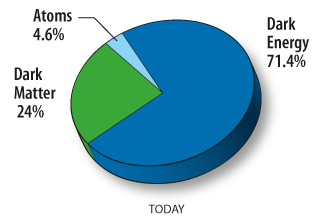
Bob Nichol: 'The universe is accelerating in its expansion'. The expansion is caused by 'dark energy' (24:00) a term for anything that could be causing this expansion - the most favoured explanation is 'vacuum energy'.
 [According to a 2003 theory] eventually galaxies will move away from each other faster than the speed of light. (24:39) In about 60 billion years the 'Big Rip' [quintessence in which dark energy destabilises] could occur and space itself might dismantle (it will be the end of the universe - all atoms will be destroyed) (24:44).
Fields permeate empty space:- Electric, magnetic, higgs and gravitational fields. Neutrinos are elementary subatomic particles which pass through us from space. (Janna Levin 25:58s)


Marcus Brigstocke investigates 'Nothing' with Jim Al-Khalili in Dara O Briain's Science Club:
Einsteins' theory of relativity proved that the aether did not exist. In space there are photons flying about everywhere. Between two electrons there are photons being emitted.
Nothing does not exist (20:34). Empty space is filled with forces (20:51), for example the force of gravity is something which Einstein thought was pulling everything together. We now know that 'vacuum energy' is making the universe expand faster and faster outwards. (21:22).
A cloud chamber demonstrates electrons and anti-electrons which have come from outer space (22:30).'
Bob Nichol: 'The universe is accelerating in its expansion'. The expansion is caused by 'dark energy' (24:00) a term for anything that could be causing this expansion - the most favoured explanation is 'vacuum energy'.
Fields permeate empty space:- Electric, magnetic, higgs and gravitational fields. Neutrinos are elementary subatomic particles which pass through us from space. (Janna Levin 25:58s)
http://scienceblogs.com/startswithabang/2011/05/16/the-fate-of-the-universe/
http://scienceblogs.com/startswithabang/2011/05/16/the-fate-of-the-universe/
Sunday, January 01, 2012
Skeptics in the Pub, Portsmouth with Jim Al-Khalili
  |
| crabsallover question to Jim Al-Khalili, HASSNERS Meetup / Skeptics in the Pub (Organisers) |
A question to Jim about parallel universes from another member of the audience.
 |
| Parallel Universes - Do they exist? |

Jim Al-Khalili talks about time travel, the Universe from Nothing, the big bang and more...
Tuesday, September 06, 2011
How Everything was formed from Nothing
This is the preview of the two programmes. The full length programmes are no longer available but I reviewed them (see below) before the BBC took them down. Lets hope there is a book out on the 2 part series.
source: http://www.bbc.co.uk/iplayer/episode/b00zwndy/Everything_and_Nothing_Nothing/ - available to view until 4th April 2011.
or on youtube:
Transcript (partial) of 'Nothing'
What is 'Nothing'? Wherever you look around you, there is always something there. To the best of our knowledge the universe 14 billion years ago appeared out of nothing. For over a 1000 years Aristotle defined our notion of empty space - 'Nature abhors a vacuum'. The whole mystery of nothingness is contained in a straw. Its as if the universe won't make nothingness. Nature it seems is so intent on stopping me that gravity is suspended (6'11"). By the 17th Century Evangelista Torricelli found exceptions to Natures abhorence of empty space. With mercury tube, mercury stops - created an airless space, an empty space and showed that the atmosphere has a specific weight. - we live at the bottom of an ocean of air. Over at 1000 years of thinking began to crumble. (8'36") Torricelli was right, Blaise Pascall discovered that the pressure of the air fell as you go higher. Space is cold and silent. Nothing is everywhere. Our Earth floats in a vacuum. A vacuum is natures default state (10'53"). What are the properties of nothingness? Placing a ringing bell inside a vacuum the bell is silent. but light (not sound) travels through the vacuum. Hence must be a medium to carry the light waves. The nothingness was still carrying waves of light. Hence luminiferous ether - the light carrying fluid that fills all of space. At the moment that there was empty space, the ether replaced the empty space. Albert Michaelson - USA first Nobel prize winner, showed from the speed of light measurements, that ether did not exist. (15'). In 1887 Michaelson with Edward Morley built an apparatus, a bath suspended in mercury (17'). The earth was not moving through a stationary ether. Light always travelled at the same speed and this meant that there was no ether. In 1905 Einstein showed that light could propagate through empty space. (22'). The vacuum led to the TV and the light bulb. (23') The filament in a bulb if exposed to air would burn out instantly so vacuum was important. X-Rays were discovered in 1895, the electron in 1896 and Ernest Rutherford discovered the nature of the atom. Quantum Mechanics behaves differently from the world we are used to - a world where we can not truly have nothing. 26'. Heisenberg's Uncertainty Principle - nature is based on uncertainty. Analogy - high resolution image versus video file. Same size files (MB). In video, balls are fuzzy and blurred although you know where something is. In quantum world cannot know exactly the position and speed of particles. In the quantum world you cannot know both time and position exactly. This is an inescapable feature of reality at this scale.
The Box (28' 56" to 32' 20")

So what has all this quantum weirdness to do with nothing? Heisenberg Uncertainty Principle (HUP) can also be expressed in a differant way, not time and position, but in terms of a balance between other quantities: energy and time. If I were to exam a small volume of empty space inside this box then I could in principle know how much energy it contains very precisely, but if were able to slow time down, things would start to get very strange. 29'45" If we look at a tiny interval of time that has been stretched out, HUP tells us because I'm looking at a smaller interval of time, I've lost precise information about the exact energy in the box. 30' 12" If I could exam an even smaller interval of time and an even smaller volume inside the box, then Heisenbergs equation suggests something trully bizare could happen. I would be so uncertain about how much energy there was in that part of the box, that there is a chance that it could contain enough energy to create particles literally out of nowhere, provided somehow the particles went away again very quickly. 31' Heisenbergs Uncertainty Principle suggests that in truly tiny amounts of time and space something could come from nothing.
crabsallover says 'this last section could described in terms of E=mc2 in Frank Closes' book 'Nothing', AVSI.
['Einstein's famous equation E=mc2 can be re-arranged to m=E/c2, which says that mass can be produced from energy. An electron and its anti-matter twin, the positron, have the same mc2 and equal and opposite signs of electric charge. So if the energy exceeds 2mc2 it is possible for an electron and a positron to emerge. The energy fluctuations in the vacuum can spontaneously turn into electrons and positrons but constrained by uncertainty principle to last only a brief moment of less than h/2mc2, (where h=Plancks Constant -p. 95) which amounts to a mere 10-21 s. This time is so small that light would been able to travel only across about one thousandth the span of a hydrogen atom. Such 'virtual particles' cannot be seen any more than the deviation from energy conservations that these fluctuations amount to.] Ref: Frank Close, Nothing, A Very Short Introduction, OUP, 2009, pp. 106-107.
But then what? 31' 16" If particles could pop into existence, where do the particles go? Why don't we see these particles appearing all around us?
31' 30" The vacuum is alive with quantum fluctuations. In the vacuum little packets of energy appear and disappear very very quickly. This is perfectly allowed by the laws of physics. This is HUP which tells us you can borrow energy from nothing as long as you pay it back quickly enough. The vacuum is alive. Bizarre as these ideas seem, they are, I promise you, fundamental to our universe. To see how this can be, our story of nothing takes us to one of the oddest characters in physics.
Paul Dirac
32' 26" In Bishop Road Primary School in Bristol was Paul Dirac. Graham Farmelo, Author: The strangest Man: The life of Paul Dirac says ' Dirac was a queer bird! Someone of rectilinear thought. He would not speak unessesarily - A Dirac - the unit of shyness is the smallest number of words you can speak in an hour but still taking part in the conversation. By 1928 the 2 most important theories in physics didn't agree with each other: Einsteins special theory of relativity E=MC2 and Planks discovery of the quantum - the bizarre rules of the very small. Where smallness and speed combine - eg electron - could give a mathematical description. Quantum physics and relativity were married together, were unified by Dirac. A radical new picture of nothing. 38' 20" His favourite film: 2001 - A Space Oddity.

The Box, Part 2 (41'-44')
In 1928 Dirac described the electron in terms of Einsteins Relativity and QM. The Dirac Equation is profoundly beautiful compressed equation. Concept of empty space. 4 equations needed. Concept of Gamma.
42' The electron is also an anti-electron - has opposite properties like charge. Many anti-electrons give anti-atoms giving anti-matter. If matter and anti-matter ever met they would instantly annihilate each other converting all their mass into energy, disappearing completely. Here finally was the answer to the riddle of empty space. HUP suggested that matter could pop into existence for incredibly short periods of time. Now Dirac had provided the mechanism by which matter could be created out of the vacuum and just as quickly disappear again. Whenever a particle pops out of empty space, so simultaneously, does its anti-particle. Whenever you try to remove everything from empty space 44'27" its still awash with all these fluctuations. Within nothingness there is a kind of fizing, a dynamic dance as pairs of particles and anti-particles, borrow energy from the vacuum for brief moments, before annihilating and paying it back again.
45' Dirac picture of the vacuum as matter - antimatter. The vacuum goes from nothing to a place absolutely teeming with matter anti-matter creation. Diracs ideas were refined to Quantum Field Theory. These strange fleeting things within nothing became known as virtual particles. Nothingness is a seething mass of virtual particles 46'23" appearing and disappearing trillions of times in a blink of an eye.
46' 50" Willis Lamb showed activity within apparent nothingness. He showed that orbits of electrons were wobbling ever so slightly due to the virtual particles in the vacuum. Analogy - the electron is like a plane hitting turbulence forcing it to move up to a higher altitude. The peak shows that the vacuum is filled with energy. The theory HUP and Dirac matches reality and the theory of Quantum Mechanics is the most powerful description of the real world.


 51' Today our best theories tell us that as the universe sprang from the vacuum, the rules of the quantum world should have contributed to the large scale of the entire cosmos. When our universe first came into existence it was many times smaller than an atom, its governed by the quantum world rules. Our universe is just the quantum world inflated many many times.

Nothing really has shaped everything. We have a way to see this. The picture of the first light after the big bang led by George Smout, like an embryo after 12 hours after human conception. Tiny variations in temperature were revealed - which are the scars left on our quantum universe.

The matter did not spred out completey evenly. It formed vast clumps which make up the galaxies today. All the galaxies started life as a quantum fluctuation of the vacuum. The quantum world has shaped everything we see around us. The quantum flucations were the seeds of our galaxies. 55'43" OUr best theories today tell us that the Universe sprang from the vacuum creating matter and anti-matter as predicted by Paul Dirac. But the universe we see today is made of matter.Nearly all the anti-matter has vanished. According to current theory the big bang produced equal amounts of matter and anti-matter but as the universe cooled down matter and anti-matter anhilated almost perfectly, but not quite! For every billion particles of antimatter and matter, one particle of matter was left behind. The anahilation gave the heat of the big bang which is today seen as the microwave background radiation.
The one in a billion parts of matter left behind makes galaxies and people. We are the leftovers of an unimaginable explosion. 58'50" Their is a profound connection between the nothingness from which we originated and the infinite that in which we are engulfed.

Comments http://topdocumentaryfilms.com/everything-and-nothing/#disqus_thread
'crabsallover says 'agentless act = nothing vacuum = anti-matter & matter collide = Big Bang = quantum fluctuations = universe = galaxies = life = us = Everythbing from Nothing!'

source: http://www.bbc.co.uk/iplayer/episode/b00zwndy/Everything_and_Nothing_Nothing/ - available to view until 4th April 2011.
or on youtube:
Transcript (partial) of 'Nothing'
What is 'Nothing'? Wherever you look around you, there is always something there. To the best of our knowledge the universe 14 billion years ago appeared out of nothing. For over a 1000 years Aristotle defined our notion of empty space - 'Nature abhors a vacuum'. The whole mystery of nothingness is contained in a straw. Its as if the universe won't make nothingness. Nature it seems is so intent on stopping me that gravity is suspended (6'11"). By the 17th Century Evangelista Torricelli found exceptions to Natures abhorence of empty space. With mercury tube, mercury stops - created an airless space, an empty space and showed that the atmosphere has a specific weight. - we live at the bottom of an ocean of air. Over at 1000 years of thinking began to crumble. (8'36") Torricelli was right, Blaise Pascall discovered that the pressure of the air fell as you go higher. Space is cold and silent. Nothing is everywhere. Our Earth floats in a vacuum. A vacuum is natures default state (10'53"). What are the properties of nothingness? Placing a ringing bell inside a vacuum the bell is silent. but light (not sound) travels through the vacuum. Hence must be a medium to carry the light waves. The nothingness was still carrying waves of light. Hence luminiferous ether - the light carrying fluid that fills all of space. At the moment that there was empty space, the ether replaced the empty space. Albert Michaelson - USA first Nobel prize winner, showed from the speed of light measurements, that ether did not exist. (15'). In 1887 Michaelson with Edward Morley built an apparatus, a bath suspended in mercury (17'). The earth was not moving through a stationary ether. Light always travelled at the same speed and this meant that there was no ether. In 1905 Einstein showed that light could propagate through empty space. (22'). The vacuum led to the TV and the light bulb. (23') The filament in a bulb if exposed to air would burn out instantly so vacuum was important. X-Rays were discovered in 1895, the electron in 1896 and Ernest Rutherford discovered the nature of the atom. Quantum Mechanics behaves differently from the world we are used to - a world where we can not truly have nothing. 26'. Heisenberg's Uncertainty Principle - nature is based on uncertainty. Analogy - high resolution image versus video file. Same size files (MB). In video, balls are fuzzy and blurred although you know where something is. In quantum world cannot know exactly the position and speed of particles. In the quantum world you cannot know both time and position exactly. This is an inescapable feature of reality at this scale.
The Box (28' 56" to 32' 20")

So what has all this quantum weirdness to do with nothing? Heisenberg Uncertainty Principle (HUP) can also be expressed in a differant way, not time and position, but in terms of a balance between other quantities: energy and time. If I were to exam a small volume of empty space inside this box then I could in principle know how much energy it contains very precisely, but if were able to slow time down, things would start to get very strange. 29'45" If we look at a tiny interval of time that has been stretched out, HUP tells us because I'm looking at a smaller interval of time, I've lost precise information about the exact energy in the box. 30' 12" If I could exam an even smaller interval of time and an even smaller volume inside the box, then Heisenbergs equation suggests something trully bizare could happen. I would be so uncertain about how much energy there was in that part of the box, that there is a chance that it could contain enough energy to create particles literally out of nowhere, provided somehow the particles went away again very quickly. 31' Heisenbergs Uncertainty Principle suggests that in truly tiny amounts of time and space something could come from nothing.
crabsallover says 'this last section could described in terms of E=mc2 in Frank Closes' book 'Nothing', AVSI.
['Einstein's famous equation E=mc2 can be re-arranged to m=E/c2, which says that mass can be produced from energy. An electron and its anti-matter twin, the positron, have the same mc2 and equal and opposite signs of electric charge. So if the energy exceeds 2mc2 it is possible for an electron and a positron to emerge. The energy fluctuations in the vacuum can spontaneously turn into electrons and positrons but constrained by uncertainty principle to last only a brief moment of less than h/2mc2, (where h=Plancks Constant -p. 95) which amounts to a mere 10-21 s. This time is so small that light would been able to travel only across about one thousandth the span of a hydrogen atom. Such 'virtual particles' cannot be seen any more than the deviation from energy conservations that these fluctuations amount to.] Ref: Frank Close, Nothing, A Very Short Introduction, OUP, 2009, pp. 106-107.
But then what? 31' 16" If particles could pop into existence, where do the particles go? Why don't we see these particles appearing all around us?
31' 30" The vacuum is alive with quantum fluctuations. In the vacuum little packets of energy appear and disappear very very quickly. This is perfectly allowed by the laws of physics. This is HUP which tells us you can borrow energy from nothing as long as you pay it back quickly enough. The vacuum is alive. Bizarre as these ideas seem, they are, I promise you, fundamental to our universe. To see how this can be, our story of nothing takes us to one of the oddest characters in physics.
Paul Dirac
32' 26" In Bishop Road Primary School in Bristol was Paul Dirac. Graham Farmelo, Author: The strangest Man: The life of Paul Dirac says ' Dirac was a queer bird! Someone of rectilinear thought. He would not speak unessesarily - A Dirac - the unit of shyness is the smallest number of words you can speak in an hour but still taking part in the conversation. By 1928 the 2 most important theories in physics didn't agree with each other: Einsteins special theory of relativity E=MC2 and Planks discovery of the quantum - the bizarre rules of the very small. Where smallness and speed combine - eg electron - could give a mathematical description. Quantum physics and relativity were married together, were unified by Dirac. A radical new picture of nothing. 38' 20" His favourite film: 2001 - A Space Oddity.

The Box, Part 2 (41'-44')
In 1928 Dirac described the electron in terms of Einsteins Relativity and QM. The Dirac Equation is profoundly beautiful compressed equation. Concept of empty space. 4 equations needed. Concept of Gamma.
42' The electron is also an anti-electron - has opposite properties like charge. Many anti-electrons give anti-atoms giving anti-matter. If matter and anti-matter ever met they would instantly annihilate each other converting all their mass into energy, disappearing completely. Here finally was the answer to the riddle of empty space. HUP suggested that matter could pop into existence for incredibly short periods of time. Now Dirac had provided the mechanism by which matter could be created out of the vacuum and just as quickly disappear again. Whenever a particle pops out of empty space, so simultaneously, does its anti-particle. Whenever you try to remove everything from empty space 44'27" its still awash with all these fluctuations. Within nothingness there is a kind of fizing, a dynamic dance as pairs of particles and anti-particles, borrow energy from the vacuum for brief moments, before annihilating and paying it back again.
45' Dirac picture of the vacuum as matter - antimatter. The vacuum goes from nothing to a place absolutely teeming with matter anti-matter creation. Diracs ideas were refined to Quantum Field Theory. These strange fleeting things within nothing became known as virtual particles. Nothingness is a seething mass of virtual particles 46'23" appearing and disappearing trillions of times in a blink of an eye.
46' 50" Willis Lamb showed activity within apparent nothingness. He showed that orbits of electrons were wobbling ever so slightly due to the virtual particles in the vacuum. Analogy - the electron is like a plane hitting turbulence forcing it to move up to a higher altitude. The peak shows that the vacuum is filled with energy. The theory HUP and Dirac matches reality and the theory of Quantum Mechanics is the most powerful description of the real world.


Nothing really has shaped everything. We have a way to see this. The picture of the first light after the big bang led by George Smout, like an embryo after 12 hours after human conception. Tiny variations in temperature were revealed - which are the scars left on our quantum universe.

The matter did not spred out completey evenly. It formed vast clumps which make up the galaxies today. All the galaxies started life as a quantum fluctuation of the vacuum. The quantum world has shaped everything we see around us. The quantum flucations were the seeds of our galaxies. 55'43" OUr best theories today tell us that the Universe sprang from the vacuum creating matter and anti-matter as predicted by Paul Dirac. But the universe we see today is made of matter.Nearly all the anti-matter has vanished. According to current theory the big bang produced equal amounts of matter and anti-matter but as the universe cooled down matter and anti-matter anhilated almost perfectly, but not quite! For every billion particles of antimatter and matter, one particle of matter was left behind. The anahilation gave the heat of the big bang which is today seen as the microwave background radiation.
The one in a billion parts of matter left behind makes galaxies and people. We are the leftovers of an unimaginable explosion. 58'50" Their is a profound connection between the nothingness from which we originated and the infinite that in which we are engulfed.

Comments http://topdocumentaryfilms.com/everything-and-nothing/#disqus_thread
'crabsallover says 'agentless act = nothing vacuum = anti-matter & matter collide = Big Bang = quantum fluctuations = universe = galaxies = life = us = Everythbing from Nothing!'

From the BBC:-
'Two-part documentary which deals with two of the deepest questions there are - what is everything, and what is nothing?
'Two-part documentary which deals with two of the deepest questions there are - what is everything, and what is nothing?
In two epic, surreal and mind-expanding films, Professor Jim Al-Khalili searches for an answer to these questions as he explores the true size and shape of the universe and delves into the amazing science behind apparent nothingness.
The second part, Nothing, explores science at the very limits of human perception, where we now understand the deepest mysteries of the universe lie. Jim sets out to answer one very simple question - what is nothing? His journey ends with perhaps the most profound insight about reality that humanity has ever made. Everything came from nothing. The quantum world of the super-small shaped the vast universe we inhabit today, and Jim can prove it.'
Jim Al-Khalili on Desert Island Discs.
Jim Al-Khalili on Desert Island Discs.
Tuesday, November 25, 2008
We can't hide in our labs and leave the talking to Dawkins

by Jim Al-Khalili
Reposted from:
http://www.guardian.co.uk/commentisfree/2008/nov/25/comment-science-secularism-society-dawkins via http://richarddawkins.net/article,3372,n,n
Image: wikipedia commons
But, alas,
Of course, Du Sautoy will not, and probably should not, need to change what he does in his new role. He is already a successful broadcaster and author as well as a serious academic. And I certainly do not intend to offer him advice on the path he should take.
By positioning himself on one extreme, Dawkins has allowed this cuddlier atheist to occupy the centre ground. It is rather like the political spectrum of the latter half of the last century, when communism provided the buffer and excuse for the respectability of socialism. Today's world is very different, and with communism discredited, those of us who proudly labelled ourselves socialists in Thatcherite Britain now feel safer being re-branded as liberals with socialism the new extreme of the left.
I do feel strongly however that those scientists who have a voice must be doing more than simply popularising their field to attract the next generation into science. Yes, this is vital; but
• Jim Al-Khalili is professor of physics and professor of the public engagement in science at the University of Surrey j.al-khalili@surrey.ac.uk
http://www.guardian.co.uk/commentisfree/2008/nov/25/comment-science-secularism-society-dawkins via http://richarddawkins.net/article,3372,n,n
Image: wikipedia commons

While people still cling to beliefs from the dark ages, more scientists must publicly defend rational, secular society.I have come to the conclusion I don't like the phrase "science communicator". You would think that it goes without saying that all scientists must communicate their work, for what is the point of learning new things about how the world works if you don't tell anyone about them?
But, alas,
the term "science communicator" seems to be reserved only for that small minority of scientists - increasing though its numbers have been in recent years - who recognise the importance of sharing their theories and observations with more than just the dozen researchers around the worldwho bother to read their highly specialised journal papers.
An even smaller minority, though - and I brazenly include myself - don't so much stick their heads shyly over the parapets of their ivory towers to peer out at the big wide world as jump out on to the ledge with a loudspeaker.But a question I wish to address here is one that does not receive a universal answer.
Should these science explainers restrict themselves in their public utterances to their own subject, or are they right to join in with other social commentators in the public arena to opine on wider societal issues such as ethics or faith?Which brings me to my reason for writing this piece. Richard Dawkins, that less than shy champion of militant atheism, stepped down recently from his famous Charles Simonyi chair in science communication at Oxford. His successor is the youthful professor of mathematics Marcus du Sautoy. This is a great appointment, as Du Sautoy is already doing the sort of things this chair was created for. But Dawkins's stature and reputation have raised the profile of the Simonyi chair, making it a platform for utterances that are hugely magnified in their reach and influence. In a way it is similar to what Stephen Hawking has brought to the Lucasian chair of mathematics at Cambridge - from which he retires next year - despite previous holders including the likes of Isaac Newton.
science explainers instead of science communicators
Of course, Du Sautoy will not, and probably should not, need to change what he does in his new role. He is already a successful broadcaster and author as well as a serious academic. And I certainly do not intend to offer him advice on the path he should take.
But whether or not one agrees with Dawkins's confrontational, firebrand style, there is no denying that he has made moderate atheism - that which tries hard not to insult those of faith by trivialising what they hold dear - respectable.
By positioning himself on one extreme, Dawkins has allowed this cuddlier atheist to occupy the centre ground. It is rather like the political spectrum of the latter half of the last century, when communism provided the buffer and excuse for the respectability of socialism. Today's world is very different, and with communism discredited, those of us who proudly labelled ourselves socialists in Thatcherite Britain now feel safer being re-branded as liberals with socialism the new extreme of the left.
I do feel strongly however that those scientists who have a voice must be doing more than simply popularising their field to attract the next generation into science. Yes, this is vital; but
it is also vital that we help defend our rational, secular society against the rising tide of irrationalism and ignorance. Science communicators, for want of a better term for now, have a role to play in explaining not just the scientific facts but how science itself works: that it is not just "another way of viewing the world"; and that without it we would still be living in the dark ages.I do not mean that everyone should become an expert in quantum mechanics (although wouldn't that be great). But when
We should be popularising "the scientific method" - which is the vision and mission of BHA Science and the meaning of Scientific within HASSERS.
there are so many people (such as the thankfully defeated Republican vice-presidential candidate in the US) who truly believe that dinosaurs roamed the earth at the same time as humans, or that the universe itself was created six thousand years ago - or who spend millions of pounds on homeopathic remedies or magic crystals instead of real medicine - then we scientists simply cannot hide away in our labs.I have recently been involved in making a BBC series on medieval science in the early Islamic empire. While we marvel at the contributions to mathematics, astronomy and medicine that these scholars made a millennium ago, we tend to scoff at the more naive notions they entertained in folklore, astrology or alchemy - until we remember that they wouldn't look so out of place in 21st-century Europe or America.
Science communicators are therefore more than just cheap popularisers providing soundbites for a public hungry to know what subatomic exotica will be conjured into existence at the Large Hadron Collider. They have a huge role to play in keeping the light of rationalism shining brightly. Love him or loathe him, Dawkins has played his part in this.
• Jim Al-Khalili is professor of physics and professor of the public engagement in science at the University of Surrey j.al-khalili@surrey.ac.uk
Subscribe to:
Posts (Atom)