John Gray
Friday, March 08, 2013
Offline: Rebelling against the dictatorship of reason : The Lancet
Friday, March 01, 2013
Religious Child Maltreatment by Janet Heimlich. A talk at Conway Hall on 7th March 2013
source: atheists-213-announce@meetup.com; on behalf of; Sue M says:-
"Breaking Their Will - Religious Child Maltreatment is being discussed at a meeting in Conway Hall next Thursday, March 7, 2013, 7:00 PM, CONWAY HALL, 25 RED LION LANE SQUARE
London WC1R 4RL. Meeting details.
Award-winning journalist, Janet Heimlich, exposes a dark side of faith that most people do not know exists or have ignored for a long time-religious child maltreatment. After speaking with dozens of victims, perpetrators, and experts .... see her kindle book: Breaking Their Will - Religious Child Maltreatment
This is a subject I have tried to raise over the years because it is always assumed that religion is good for children. Yet there are many issues on which religion exploits children and does them harm.
Current emphasis concentrates on child sex abuse by priests and celebrities, but the harm it does to children is much deeper and more fundamental than that.
There is a list on this website that I compiled many years ago: Children and Religion on workshop3
Wednesday, January 02, 2013
Spirituality 'link' to mental illness
source: http://www.nhs.uk/news/2013/01January/Pages/Spirituality-link-to-mental-illness.aspx
“Spiritual people are more likely to be mentally ill”, the Daily Mail reports.
HASSNERS.org highlights
Wed Jan 2, 2013 09:51
![]() |
| People with ‘spiritual views’, but not conventional religious beliefs, had higher rates of drug use |
Its headline is based on results from a survey of over 7,000 people in England. The research identified a group of people described as having a “spiritual understanding of life” but not practicing organised religion (for example, attending church regularly).
Researchers found this group were more likely to have a variety of mental health disorders and substance misuse problems than those describing themselves as religious and those reporting neither a religious nor a spiritual understanding of life (which for ease of reference, we will describe as atheists).
It is tempting to conclude that having a spiritual understanding of life (without a religious framework of regular worship) somehow causes more mental health problems, potentially through lack of social support increasing a person’s vulnerability.
However, it is equally valid to conclude that mental health problems cause people to develop a spiritual understanding of life, potentially through searching for alternative answers and explanations for their problems (as the American blues singer Bonnie Raitt put it, ‘Religion is for people who are scared to go to hell. Spirituality is for people who have already been there’).
This highlights the main limitation of this cross-sectional research – that it cannot prove cause and effect. It cannot prove which came first: spirituality or mental ill health.
Further research is needed to explore this potential link and how it may differ from person to person or culture to culture.
Where did the story come from?
The study was carried out by researchers from University College London.
The funding source was not stated in the online publication, but no conflicts of interest were declared.
The study was published in The British Journal of Psychiatry, a peer-reviewed medical journal.
The media reporting was generally accurate, although the significant limitations of the study were not highlighted.
What kind of research was this?
This was a cross-sectional study aiming to examine the association between a “spiritual or religious understanding of life” and symptoms or diagnoses of mental health problems and substance abuse. Cross-sectional studies are useful, but their main limitation is that they cannot prove cause and effect, only that two things are in some way related. This study was not designed to be able to tell us whether spirituality actually causes differences in mental health, only whether they are related.
What did the research involve?
The researchers analysed information collected from 7,403 randomly selected people who participated in the third National Psychiatric Morbidity Survey in England between October 2006 and December 2007. This was a survey commissioned by the National Centre for Social Research, an independent research agency with an interest in social attitudes.
The survey used standardised interview questions to ask about demographic characteristics, religious and spiritual belief, and aspects of common mental health disorders and substance abuse.
The interview surveys were wide ranging and covered questions on subjects such as:
- happiness
- phobias
- anxiety disorders
- alcohol misuse
- eating disorders
- gambling addiction
- drug use
- psychological trauma
- aspects of social support
Participants were provided with the following statement to help clarify the spirituality questions, “by religion, we mean the actual practice of a faith, e.g. going to a temple, mosque, church or synagogue. Some people do not follow a religion but do have spiritual beliefs or experiences. Some people make sense of their lives without any religious or spiritual belief”. The main question asked participants “would you say that you have a religious or spiritual understanding of your life?” with the available answers of religious, spiritual, or neither.
The survey results were appropriately “weighted” to take account of non-response to the survey and to make the results more representative of the English population as a whole.
The statistical analyses were also adjusted to take into account differences due to gender, age, ethnicity, educational attainment, marital status and perceived social support. Social support, the authors stated, is known to be associated with religious belief and practice.
What were the basic results?
A total of 13,171 people were contacted to take part in the interview survey, of which 7,403 (56.2%) responded.
Those that took part were 46.3 years old on average, 51.4% were women and 85% were ‘white British’. Of these, 35% had a religious understanding of life (86% stating they were Christian), 19% were spiritual but not religious, and the largest group were neither religious nor spiritual (46%).
Prevalence of mental health disorders was similar between the group of religious people and those with neither religious nor spirituality tendencies, except that religious people were less likely to have used drugs or be a hazardous drinker.
Spiritual people were more likely than those with neither religious nor spiritual beliefs to:
- have ever used drugs
- be dependent on drugs
- have abnormal eating attitudes
- have generalised anxiety disorder
- have a phobia
- have a neurotic disorder
- to take psychotropic medication (medication that affects brain function) such as antidepressants or antipsychotics
How did the researchers interpret the results?
The researchers concluded that, “people who have a spiritual understanding of life in the absence of a religious framework are vulnerable to mental disorder.”
Conclusion
This large national cross-sectional survey suggested English people self-identifying as spiritual (without religion) may be more likely to suffer a range of mental health disorders and substance abuse than those identifying as having neither a spiritual nor a religious understanding of life. Those with a religious understanding of life were broadly similar to the group without a religious or spiritual outlook for the majority of mental health conditions assessed.
This national survey highlights a potential link between having a spiritual understanding of life and worse mental health compared to other outlooks on life.
However, there are many limitations to this research that should be considered when interpreting the results:
- First and foremost is that this, and all cross-sectional surveys, cannot prove cause and effect. Therefore, it is uncertain whether mental ill-heath in some way causes people to take a more spiritual view of life or whether a spiritual understanding of life is somehow detrimental to mental health. For example, people who have experienced long-term mental health problems may find more comfort in taking a spiritual worldview than a purely rationalist one.
- Other factors may be at play, for example, people who describe themselves as spiritual may be more willing to use complementary and alternative medicines to treat conditions such as depression, which may be less effective than conventional medications.
- Despite the researchers’ best efforts, the participants in the survey may not be generally representative of the English population. For example, the ‘religious group’ were mainly white British Christians of middle age and so the findings may be less applicable to other groups.
- The absolute numbers in the different groups were not reported, only the differences in percentages. And without knowing the numbers of people suffering mental health or substance abuse problems in the sample, it is not possible to assess the importance of these results. For example, the researchers say that religious people were 27% less likely to have ever used drugs (odds ratio 0.73, 95% confidence interval 0.60 to 0.88 compared to those who were neither religious nor spiritual. Without knowing how many in this population were using drugs it is not possible to say what this means in terms of how many fewer people this represents – a 27% decrease could range from just one person to thousands.
Further research is needed to explore this potential link and establish any causality and its direction. Based on this research alone, we should not conclude that having a spiritual understanding of life is bad for your mental health.
Links To The Headlines
Spiritual people are more likely to be mentally ill (but at least they think life has more meaning). Daily Mail, January 2 2012
'Spiritual' people at higher risk of mental health problems. The Daily Telegraph, January 2 2012
Links To Science
King M, Marston L, McManus S, et al. Religion, spirituality and mental health: results from a national study of English households. British Journal of Psychiatry. Published online November 22 2012
Monday, December 31, 2012
work out the speed of light by making cheese on toast.
source: http://www.youtube.com/watch?v=_t0EgviIbR0
41:04 - Dara O'Briain works out the speed of light by making cheese on toast.
A microwave travels at the speed of light.
speed of light = frequency x wavelength
6.5cm between hot spots of cheese x 2 = wavelength = 13cm = 0.13metres
frequency (from back of microwave) = 2450 MHz = 2.45 x 10⁹ giga hertz
calculated speed of light = 0.13m x 2.45 x109 = 3.2 x 10⁸ m/s
Actual speed of light is 3.0 x 10⁸ m/s (300,000 km/s=3 x 105 km/s)
Pretty close, eh!
HASSNERS.org highlights
HASSNERS.org comments
41:04 - Dara O'Briain works out the speed of light by making cheese on toast.
A microwave travels at the speed of light.
speed of light = frequency x wavelength
6.5cm between hot spots of cheese x 2 = wavelength = 13cm = 0.13metres
frequency (from back of microwave) = 2450 MHz = 2.45 x 10⁹ giga hertz
calculated speed of light = 0.13m x 2.45 x109 = 3.2 x 10⁸ m/s
Actual speed of light is 3.0 x 10⁸ m/s (300,000 km/s=3 x 105 km/s)
Pretty close, eh!
Marcus Brigstocke investigates 'Nothing'
source: http://www.youtube.com/watch?v=_t0EgviIbR0
From 17:45s:
Marcus Brigstocke investigates 'Nothing' with Jim Al-Khalili in Dara O Briain's Science Club:
Einsteins' theory of relativity proved that the aether did not exist. In space there are photons flying about everywhere. Between two electrons there are photons being emitted.
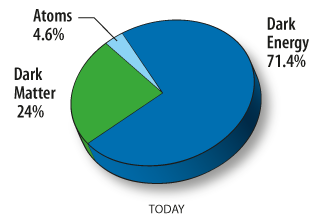
Nothing does not exist (20:34). Empty space is filled with forces (20:51), for example the force of gravity is something which Einstein thought was pulling everything together. We now know that 'vacuum energy' is making the universe expand faster and faster outwards. (21:22).
(NB. One contribution to the vacuum energy are from virtual particles - particle pairs that blink into existence and then annihilate in a timespan too short to observe. They are expected to do this everywhere, throughout the Universe.)
A cloud chamber demonstrates electrons and anti-electrons which have come from outer space (22:30).'
Bob Nichol: 'The universe is accelerating in its expansion'. The expansion is caused by 'dark energy' (24:00) a term for anything that could be causing this expansion - the most favoured explanation is 'vacuum energy'.
[According to a 2003 theory] eventually galaxies will move away from each other faster than the speed of light. (24:39) In about 60 billion years the 'Big Rip' [quintessence in which dark energy destabilises] could occur and space itself might dismantle (it will be the end of the universe - all atoms will be destroyed) (24:44).
Fields permeate empty space:- Electric, magnetic, higgs and gravitational fields. Neutrinos are elementary subatomic particles which pass through us from space. (Janna Levin 25:58s)
http://scienceblogs.com/startswithabang/2011/05/16/the-fate-of-the-universe/
Wednesday, December 19, 2012
Pew Forum: In USA One-in-Five Adults Have No Religious Affiliation
source and Full pdf Report. My comments in blue.
Some of the religiously unaffiliated (excluding atheists and agnostics) are religious or spiritual in some way, pray each day, feel a deep connection with nature and the earth and are “spiritual” but not “religious”. A mixed bunch!
- "The number of Americans who do not identify with any religion continues to grow at a rapid pace. One-fifth of the U.S. public – and a third of adults under 30 – are religiously unaffiliated today, the highest percentages ever in Pew Research Center polling."
- "In the last five years alone, the Religiously Unaffiliated have increased from just over 15% to just under 20% of all U.S. adults. Their ranks now include more than 13 million self-described atheists and agnostics (nearly 6% of the U.S. public), as well as nearly 33 million people who say they have no particular religious affiliation (14%)"
- "This large and growing group of Americans (the religiously unaffiliated) is less religious than the public at large on many conventional measures, including frequency of attendance at religious services and the degree of importance they attach to religion in their lives."
- "many of the country’s 46 million unaffiliated adults are religious or spiritual in some way. Two-thirds of them say they believe in God (68%) though less than half say they are absolutely certain of God’s existence." ie these are NOT the Atheists & Agnostics.
- "More than half say they often feel a deep connection with nature and the earth (58%)"
- "more than a third classify themselves as “spiritual” but not “religious” (37%)"
- "one-in-five (21%) say they pray every day" (!!)
- "The growth in the number of religiously unaffiliated Americans – sometimes called the rise of the “nones” – is largely driven by generational replacement, the gradual supplanting of older generations by newer ones. A third of adults under 30 have no religious affiliation (32%), compared with just one-in-ten who are 65 and older (9%). And young adults today are much more likely to be unaffiliated than previous generations were at a similar stage in their lives."
- "most religiously unaffiliated Americans think that churches and other religious institutions benefit society by strengthening community bonds and aiding the poor"
- "typically the unaffiliated say they are not looking for a religion that would be right for them"
- "Overwhelmingly, they think that religious organizations are too concerned with money and power, too focused on rules and too involved in politics"
Tuesday, December 18, 2012
Pew - The Global Religious Landscape - The Religiously Unaffiliated
Source and pdf - Published: The Global Religious Landscape, December 18, 2012
Summary
- one-in-six people around the globe (1.1 billion, or 16%) have no religious affiliation
- the unaffiliated are the third-largest religious group worldwide, behind Christians and Muslims, and about equal in size to the world’s Catholic population
- Three-quarters of the religiously unaffiliated (76%) live in the Asia- Pacific region
- most religiously unaffiliated people (71%) live in countries in which they are the predominant religious group
- The Religiously Unaffiliated includes atheists, agnostics and people who do not identify with any particular religion in surveys. However, many of the religiously unaffiliated do hold religious or spiritual beliefs.
- More than six-in-ten (62%) of all religiously unaffiliated people live in one country, China
- There are six countries where the religiously unaffiliated make up a majority of the population
More
- "Pew Forum finds that roughly one-in-six people around the globe (1.1 billion, or 16%) have no religious affiliation. The religiously unaffiliated include atheists, agnostics and people who do not identify with any particular religion in surveys. This makes the unaffiliated the third-largest religious group worldwide, behind Christians and Muslims, and about equal in size to the world’s Catholic population." (source: pdf, pg 9)
- "Many of the religiously unaffiliated have some religious beliefs. For example, belief in God or a higher power is shared by 7% of Chinese unaffiliated adults, 30% of French unaffiliated adults and 68% of unaffiliated U.S. adults. Some of the unaffiliated also engage in certain kinds of religious practices. For example, 7% of unaffiliated adults in France and 2 7% of those in the United States say they attend religious services at least once a year. And in China, 44% of unaffiliated adults say they have worshiped at a graveside or tomb in the past year. Beliefs and practices of unaffiliated adults in the United States are documented in the Pew Forum’s October 2012 report “ ‘Nones’ on the Rise.” (source: pdf, pg 24)
- "Three-quarters of the religiously unaffiliated (76%) live in the Asia- Pacific region. The number of religiously unaffiliated people in China alone (about 700 million) is more than twice the total population of the United States." (source: pdf, pg 10)
- ''most religiously unaffiliated people (71%) live in countries in which they are the predominant religious group. The religiously unaffiliated make up a majority of the population in six countries, of which China is by far the largest. The others are the Czech Republic, Estonia, Hong Kong, Japan and North Korea." (source: pdf, pg 11)
- "The Religiously Unaffiliated includes atheists, agnostics and people who do not identify with any particular religion in surveys. However, many of the religiously unaffiliated do hold religious or spiritual beliefs. eg Belief in God or a higher power is shared by 7% of unaffiliated Chinese adults, 30% of unaffiliated French adults and 68% of unaffiliated U.S. adults". See Note 6 below (source: pdf, pg 15)
Religiously Unaffiliated
(source: pdf, pg 12)
Census 2011: 25.1% of England & Wales population are religiously unaffiliated (No religion).
- There are six countries where the religiously unaffiliated make up a majority of the population: the Czech Republic (76% are religiously unaffiliated), North Korea (71%), Estonia (60%), Japan (57%), Hong Kong (56%) and China (52%).
- 16.4% of the total U.S. population was unaffiliated as of 2010. As of 2012, 19.6% of U.S. adults are unaffiliated. (source: pdf, pg 25-26)
More than six-in-ten (62%) of all religiously unaffiliated people live in one country, China. The largest populations of the religiously unaffiliated outside China are in Japan (6% of all unaffiliated), the United States (5%), Vietnam (2%) and Russia (2%). (source: pdf, pg 25-26)
Subscribe to:
Posts (Atom)