Pages

Showing posts with label Brian Cox. Show all posts

Wednesday, January 08, 2014

YOU can Discover a NEW Galaxy from YOUR PC - Spacewarps.org

Stargazing Live: Brian Cox and Dara O Briain, Series 4, Episode 1. 

Using gravitational lensing on Spacewarps.org YOU can see the curvature of spacetime by mass by the 300 billion galaxies that have been observed to date. YOUR task is to find galaxies (each have 100 billion stars to 1 Trillion stars) that have NOT yet been observed (because they are obscured by observed galaxies). The aim is to observe half million images in 48 hours (within 12 hours 3M had been observed.

Follow progress on Facebook, on Twitter and on Spacewarps blog. Talk to your peers on the forum.

See in the low centre left with the blue ring to its left, looks like a lens to meby Darth_Hydrogen 
"Spacetime tells matter how to move; matter tells spacetime how to curve."John Archibald Wheeler


Spacewarps is a project of Zooniverse.

at 9am at 8th January 2014 (12 hours after programme televised)


Spacwarps.org has 40,000 images taken by telescopes in Chile and Hawaii.  By the curvature of space time, light from a distant galaxy is bent all the way around to produce an Einstein ring. The light has taken 7-10 billion years to reach us.


Introducing Prof (actually a 'Reader') Tim O Brien at Jodrell Bank who demonstrates an Einstein ring which is a special case of gravitational lensing (38m).


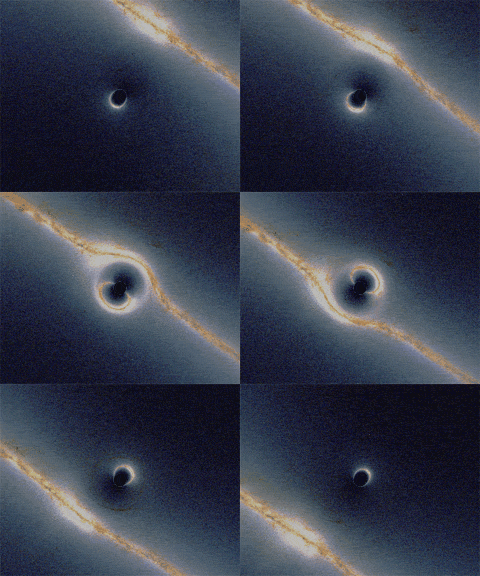
Lensing by a black hole. Animated simulation of gravitational lensing caused by a Schwarzschild black hole going past a background galaxy.


Chris Lintott from Sky at Night explains that physicists can weigh (estimate number of stars) of newly discovered galaxies behind the observed galaxy using gravitational lensing.

References (accessed 8 Jan 2014)
http://www.bbc.co.uk/iplayer/episode/b03pn6nl/Stargazing_LIVE_Series_4_Episode_1/ From 36m 20s to 41m 30s
http://www.bbc.co.uk/programmes/b03pn6nl


Sunday, March 24, 2013

How much time for life is possible?

Notes

  1. Life of Universe from Big Bang to end of Black Hole Era is 10^100 years
  2. Life as we know it formed on earth formed ~4 billon years ago and cannot last for more than another 6 billion years (when our sun becomes a red giant) = 10^10
  3. 10^10/10^100 = ~1/100% x 1/1000 x 1000,000,000 x 9 = (10^86)-1

Maths is quite right. What was the mistake I made??

Sources:

  • Wonders of the Universe, Brian Cox, Pub. Harper Collins, 2011, pg 222
  • Wonders of the Universe, Brian Cox, DVD, 2011

Saturday, October 10, 2009

The Big Bang, the LHC and the Evolution of the Creation of the Universe by Brian Cox

In "There's probably no God, the Atheists Guide to Christmas" edited by Ariane Sherine, Brian Cox has a chapter on the Big Bang titled "The Large Hadron Collider: A scientific creation story". I've summarised it and added further details from the hour long video by Brian Cox at CERN.

The LHC recreates the conditions of the universe less than a billionth of a second after the big bang. The job of the LHC is too study the universe during the time when the Higgs particles are thought to have been generated. The history of the universe is thus:

  • 13.7 billion years ago universe begins (t=0)
    • gravity separates from the other forces of nature (t+10-43 seconds)
    • exponential expansion of universe (t+10-36 s)
      • from size of electron to size of melon (t+10-32 s)
      • with formation of sub-atomic particles
        • and Higgs field (t+10-12 s)
          • gives mass to sub-atomic particles
            • Higgs acts like cosmic treacle
          • if Higgs particles aka Higgs Boson, aka The God Particle (Leon Lederman) exist (after 40 years we don't know) then Higgs Boson must be created in LHC (Standard Model)
          • Higgs particles decays too quickly to be seen even in LHC 
            • but Muon will be seen from decay of Higgs particle 
          • Higgs Boson is tens or hundreds of times heavier than the protons that were smashed together (mini big bang) to create it (E=mc2). Energy=mass
            • because Higgs particles are light enough to show up in LHC
          • if Higgs particles are NOT found in LHC 
              • some other mechanism (Minimally Supersymetric Standard Model?) will show up in LHC which creates mass
              • and explains Dark Matter
After t+10-12 s time we already know what happened to the universe because smaller cousins to LHC (eg Fermilab Tevatron?) have been working for decades:-
  • 4 forces of nature (strong nuclear, electromagnetic, weak, gravity) formed (t+10-6 s)
    • strong nuclear force
      • binds quarks together in nucleus of atom
    • electromagnetism
      • holds electrons in place around nucleus
    • weak force
      • allows sun to shine, explains radioactive decay
    • gravity
      • is missing from Standard model
        • creates infinities when gravity is added 
          • if treat particles as tiny points, when they come infinitely close together, gravity becomes infinitely strong 
          • by treating particles as strings (not tiny points) we have a way for gravity to work
      • but gravity is included in Einstein's General Relativity
        • a Theory of Everything would combine Standard model with General Relativity
        • String Theory combines all particles and forces (and makes a decent cup of coffee!)
  • quarks and leptons interact
  • quarks stick together to give protons & neutrons, neutrinos roam universe (t+1 s)
  • protons & neutrons form elements (t+3 minutes)
  • Hydrogen 75% : Helium 25% ratio fixed (t+30 m)
  • Light as Photons set free from dense universe: cosmic microwave background (t+ 380,000 years)
  • gravity collapses H & He to form stars
  • 4 forces of nature interact: x3 He fuse to give Carbon
    • more fusions give oxygen and other light elements
  • stars run out of fuel, explode 
    • scattering C & Oxygen & other light elements
    • creating Gold, Silver & other heavy elements
  • gravity forms stars & dense rocky planets orbit
  • on at least one planet, occurs self replication & life & us!
Additional material added above from the 5 YouTube videos:-

Creative Commons License
This work by crabsallover is licensed under a Creative Commons Attribution-Non-Commercial-Share Alike 2.0 UK: England & Wales License.

Sunday, May 04, 2008

Talks Brian Cox: What really goes on at the Large Hadron Collider

A neat explanation of what the CERN LHC hopes to achieve. The Higgs Boson (gives mass to particles), Supersymetry are discussed.

"Rock star physicist" Brian Cox talks about his work on the Large Hadron Collider at CERN. Discussing the biggest of big science in an engaging, accessible way, Cox brings us along on a tour of the massive complex and describes his part in it -- and the vital role it's going to play in understanding our universe.