Pages

Showing posts with label Gravitational Lensing. Show all posts

Wednesday, January 08, 2014

Gravitational Lensing - Spacewarps.org project

GRAVITATIONAL LENSING

Einstein's theory of gravity, General Relativity, made a remarkable prediction. Massive objects, such as stars, would bend the space around them such that passing light rays follow curved paths. Evidence for this revolutionary theory was first obtained by Arthur Eddington in 1919, when during a solar eclipse he observed that stars near the edge of the Sun appeared to be slightly out of position. The Sun was behaving like the lens in a magnifying glass and bending the light from the background stars!
In 1937, Fritz Zwicky realized that massive galaxies (which can contain anywhere from ten million to a hundred trillion stars) or clusters of galaxies could be used to magnify distant galaxies that conventional telescopes couldn't detect. As you can see, not unlike a conventional magnifying glass, these gravitational lenses not only magnify and focus the light of the distant background galaxies but they can, and mostly do, distort them as well.
When one of these gravitational lenses happens to sit right in front of a background galaxy, the magnification factor can be up to x10 or even more, giving us a zoomed-in view of the distant universe, just at that particular point. Lenses can help us investigate young galaxies more than halfway across the universe, as they formed stars and started to take on the familiar shapes we see nearby.
Observations of the distorted background galaxy can also give us useful information about the object that is behaving as a gravitational lens. The separation and distortion of the lensed images can tell astronomers how much mass there is in the object, and how it is arranged. It is one of the few ways we have of mapping out where the dark matter in the universe is, how clumpy it is and how dense it is near the centers of galaxies. Knowing this can provide crucial information about how galaxies evolve.

NEEDLES IN A HAYSTACK

There is a lot of interesting science to be done with gravitational lenses. The problem is that they are very rare. Only about one in a thousand massive galaxies is aligned with a background object well enough to cause it to appear multiply-imaged. We currently know of about 400 objects that are behaving as gravitational lenses, largely because we have become very good at observing the night sky! Modern optical surveys cover thousands of square degrees, with images sharp and deep enough to resolve about 1 lens per square degree. There should be thousands of lenses that we can detect, but we will need to look at millions of galaxy images to find them!
The ideal solution would be to get a computer to look through all of the images, but unfortunately this is not a straightforward solution. Teaching a computer to recognize the effects of gravitational lensing is not too difficult, but they can be easily confused by galaxies that look very similar to a distorted background galaxy. Also in order for the computer to run fast enough to analyse lots of images quickly, they have to cut a lot of corners, and this makes them less effective.

See video.

DISCOVERING LENSES: A HUMAN-COMPUTER PARTNERSHIP

Human beings have a remarkable ability to recognise patterns and detect the unusual with only minimal training. With a basic understanding of what the distorted images of galaxies that have passed through a gravitational lens look like, participants in the SpaceWarps project can help discover new examples of this amazing phenomenon, and enable our survey scientists to carry out new investigations of stars and dark matter in the universe. In the current project, we've selected galaxies, and groups of galaxies, that could potentially act as gravitational lenses, and quasars, that are very useful when gravitationally lensed, all from the VICS82 infrared imaging survey. The task is to assess whether or not gravitational lensing is actually going on in each image! There will be confusing objects around - the challenge is to come up with the most plausible explanation for what is going on, in collaboration with the rest of the Space Warps community. Do you think you can spot outer space being warped? We do!

References

http://spacewarps.org/#/about (accessed 8 Jan 2014)

YOU can Discover a NEW Galaxy from YOUR PC - Spacewarps.org

Stargazing Live: Brian Cox and Dara O Briain, Series 4, Episode 1. 

Using gravitational lensing on Spacewarps.org YOU can see the curvature of spacetime by mass by the 300 billion galaxies that have been observed to date. YOUR task is to find galaxies (each have 100 billion stars to 1 Trillion stars) that have NOT yet been observed (because they are obscured by observed galaxies). The aim is to observe half million images in 48 hours (within 12 hours 3M had been observed.

Follow progress on Facebook, on Twitter and on Spacewarps blog. Talk to your peers on the forum.

See in the low centre left with the blue ring to its left, looks like a lens to meby Darth_Hydrogen 
"Spacetime tells matter how to move; matter tells spacetime how to curve."John Archibald Wheeler


Spacewarps is a project of Zooniverse.

at 9am at 8th January 2014 (12 hours after programme televised)


Spacwarps.org has 40,000 images taken by telescopes in Chile and Hawaii.  By the curvature of space time, light from a distant galaxy is bent all the way around to produce an Einstein ring. The light has taken 7-10 billion years to reach us.


Introducing Prof (actually a 'Reader') Tim O Brien at Jodrell Bank who demonstrates an Einstein ring which is a special case of gravitational lensing (38m).


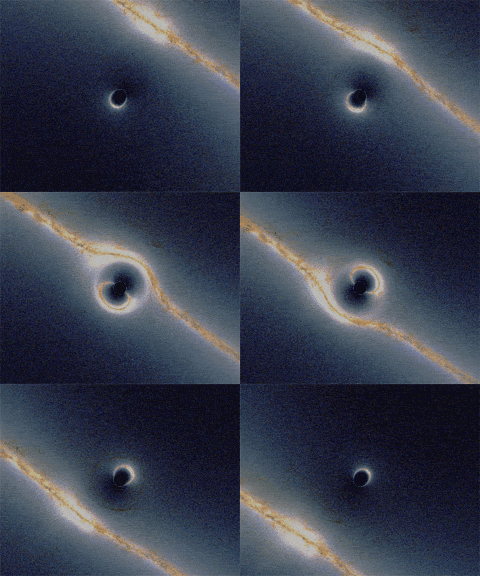
Lensing by a black hole. Animated simulation of gravitational lensing caused by a Schwarzschild black hole going past a background galaxy.


Chris Lintott from Sky at Night explains that physicists can weigh (estimate number of stars) of newly discovered galaxies behind the observed galaxy using gravitational lensing.

References (accessed 8 Jan 2014)
http://www.bbc.co.uk/iplayer/episode/b03pn6nl/Stargazing_LIVE_Series_4_Episode_1/ From 36m 20s to 41m 30s
http://www.bbc.co.uk/programmes/b03pn6nl


Sunday, August 31, 2008

Cosmic crash unmasks dark matter

By Paul Rincon
Science reporter, BBC News

MACS J0025    Image: Nasa, Esa, CXC, M. Bradac (University of California, Santa Barbara), and S. Allen (Stanford University)
Dark matter is shown in blue, ordinary matter is coloured pink

Striking evidence has been found for the enigmatic "stuff" called dark matter which makes up 23% of the Universe, yet is invisible to our eyes.

The results come from astronomical observations of a titanic collision between two clusters of galaxies 5.7 billion light-years away.

Astronomers detected the dark matter because it separated from the normal matter during the cosmic smash-up.

The research team are to publish their findings in the Astrophysical Journal.

They used the Hubble and Chandra space telescopes to study the object MACSJ0025.4-1222 - formed after an incredibly energetic collision between two large galaxy clusters.

Each of these large clusters contains about a quadrillion times the mass of our Sun.

It puts to rest all the worries that the Bullet Cluster was an anomalous case. We have gone out and found another one
Richard Massey, Royal Observatory Edinburgh

A technique known as gravitational lensing was used to map the dark matter with Hubble.

If an observer looks at a distant galaxy and some dark matter lies in between, the light from that galaxy gets distorted.

It looks as if it is being seen through lots of little lenses. And each of these lenses represents a piece of dark matter.

Astronomers used the Chandra X-ray telescope to map ordinary matter in the merging clusters, mostly in the form of hot gas, which glows brightly in X-rays.

As the two clusters that formed MACSJ0025 merged at speeds of millions of kilometres per hour, hot gas in the two clusters collided and slowed down.

However, the dark matter kept on going, passing right through the smash-up.

Speeding bullet

This phenomenon has been seen before, in a structure called the Bullet Cluster - which also formed after the collision of two large galaxy clusters. The Bullet Cluster lies closer to Earth, at a distance of 3.4 billion light-years.

"It puts to rest all the worries that the Bullet Cluster was an anomalous case. We have gone out and found another one,"

co-author Richard Massey, from the Royal Observatory Edinburgh, told BBC News.

The study sheds light on the properties of dark matter.

The fact that dark matter does not slow down in the collision supports a view that dark matter particles interact with each other only very weakly or not at all (when one excludes their gravitational interaction).

"Dark matter makes up five times more matter in the Universe than ordinary matter," said co-author Marusa Bradac, from the University of California at Santa Barbara (UCSB).

"This study confirms that we are dealing with a very different kind of matter, unlike the matter that we are made of. And we're able to study it in a very powerful collision of two clusters of galaxies."

Larger sample

The latest astronomical observations suggest that dark matter makes up some 23% of the Universe. Ordinary matter - such as the galaxies, gas, stars and planets - makes up just 4%.

The remaining 73% is made up of another mysterious quantity; dark energy, which is responsible for speeding up the expansion of the cosmos.

CMS at Cern (M. Brice/Cern)
The Large Hadron Collider may shed further light on dark matter
According to one model, dark matter may be comprised of exotic sub-atomic "stuff" known as Weakly Interacting Massive Particles (WIMPS).

Others hold that the dark substance consists of everyday matter, rather than some elusive sub-atomic particle. However, this ordinary matter, referred to as Massive Astrophysical Compact Halo Objects (MACHOS), happens to radiate little or no light.

A powerful physics experiment, the Large Hadron Collider, which is currently under construction on the French-Swiss border, could shed further light on this question after it begins operating later this year.

Dr Massey said his team had found other candidates for colliding clusters.

"Ideally, we don't want just one or two, we want lots of these things to really study them statistically," he explained.

"Then we either use the whole lot, or pick out one 'golden bullet' which will provide the best constraints on what dark matter is."

The Hubble Space Telescope failed just after the team had taken their image of MACSJ0025, so they have not yet been able to study these other candidates.

Dr Massey said the astronomers hope to do this after the next Hubble servicing mission with the space shuttle, which is due to launch in October 2008.

Paul.Rincon-INTERNET@bbc.co.uk

Physicist Patricia Burchat sheds light on two basic ingredients of our universe: dark matter and dark energy.

Comprising 96% of the universe between them, they can't be directly measured, but their influence is immense.

16 minutes, TED Seminar. Includes a practical experiment (with a wine glass!) to demonstrate Gravitational Lensing (an effect predicted by Einstein).