Jeremy Paxman interviews Professor Dawkins about The God Delusion. Richard Dawkins' asserts that belief in god is irrational and inflicts great harm upon societies.

Sunday, November 13, 2011

Monday, October 31, 2011
God is Hate!
God is Hate!

Posted: 29 Oct 2011 09:21 AM PDT
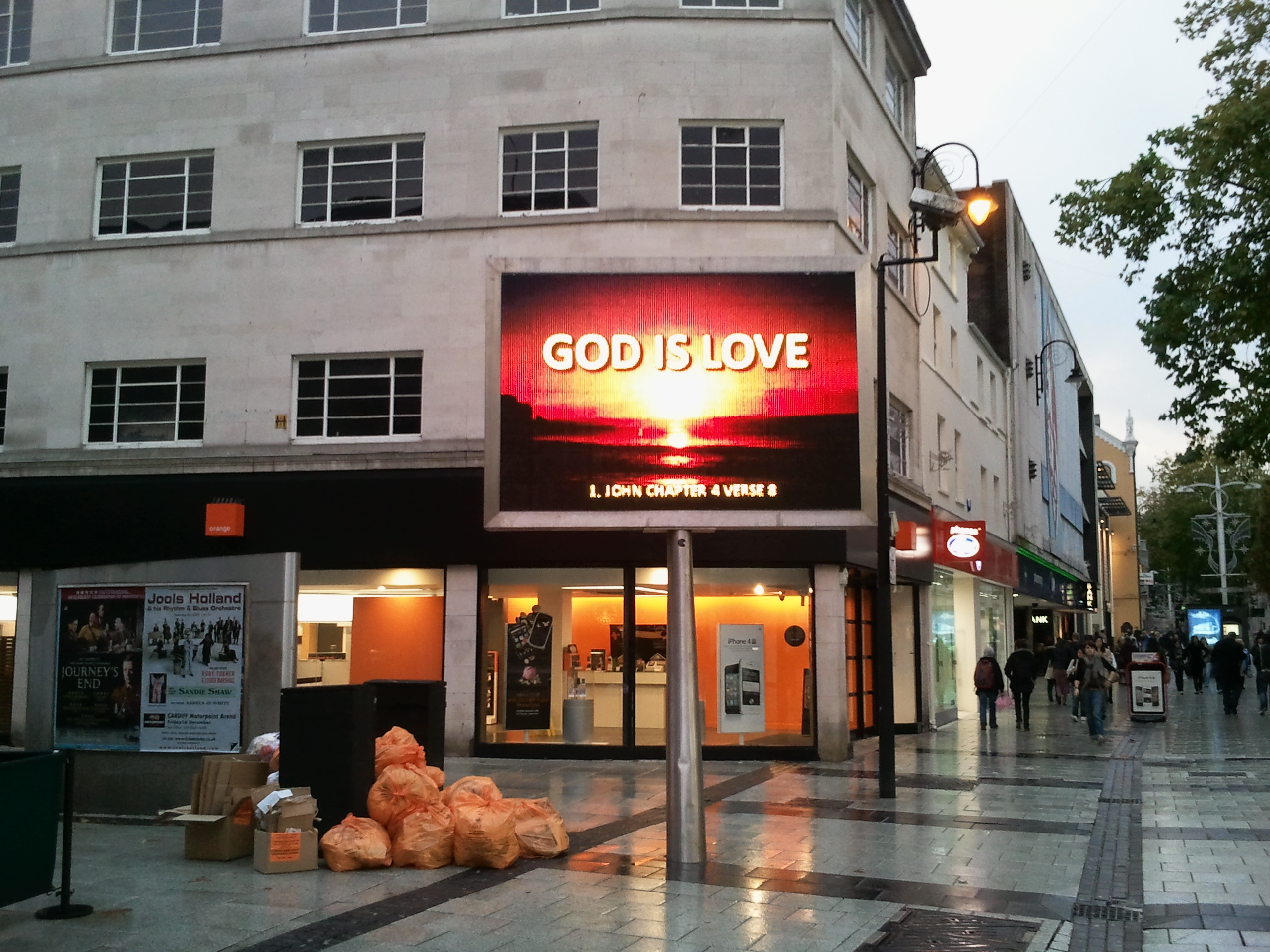
Atheism UK said via email on 31/10/11
'I came across this image amongst a slew of “normal” rolling adverts on a big screen in Cardiif City centre this week. It is, perhaps, fitting that it stands beside a pile of rubbish because that is precisely what it is; a meaningless phrase which represents not any aspect of reality, but a fantasy of its authors.
Just stating something doesn’t give it any validity. One could equally say, “God is hunger”, “God is ignorance” or “God is hate”.
We may agree that love can a positive, emotion compared to hate, but you don’t need God or religion to understand or feel love.
It is curious why the verse John 4:8,
“[6-8] The well that Jacob had dug was still there, and Jesus sat down beside it because he was tired from traveling. It was noon, and after Jesus’ disciples had gone into town to buy some food, a Samaritan woman came to draw water from the well. Jesus asked her, “Would you please give me a drink of water?” (Contemporary English Version)
was referenced as there doesn’t seem to be anything about love within it. Perhaps, they are hoping that people will read on. I wonder if anyone bothers, apart from atheists like myself who have immunity to the mythology and ignorance of religion?
Rather than the quote referenced how about Hosea 13:16,
“Samaria will be punished for turning against me.
It will be destroyed in war–
children will be beaten against rocks,
and pregnant women will be ripped open.” (Contemporary English Version)
It will be destroyed in war–
children will be beaten against rocks,
and pregnant women will be ripped open.” (Contemporary English Version)
?
Charming! This is one amongst many quotes that can be found in the bible that highlights the hatred of “God”, or rather of the men who wrote the bible and claimed divine knowledge without evidence or justification.'
Tuesday, September 06, 2011
How Everything was formed from Nothing
This is the preview of the two programmes. The full length programmes are no longer available but I reviewed them (see below) before the BBC took them down. Lets hope there is a book out on the 2 part series.
source: http://www.bbc.co.uk/iplayer/episode/b00zwndy/Everything_and_Nothing_Nothing/ - available to view until 4th April 2011.
or on youtube:
Transcript (partial) of 'Nothing'
What is 'Nothing'? Wherever you look around you, there is always something there. To the best of our knowledge the universe 14 billion years ago appeared out of nothing. For over a 1000 years Aristotle defined our notion of empty space - 'Nature abhors a vacuum'. The whole mystery of nothingness is contained in a straw. Its as if the universe won't make nothingness. Nature it seems is so intent on stopping me that gravity is suspended (6'11"). By the 17th Century Evangelista Torricelli found exceptions to Natures abhorence of empty space. With mercury tube, mercury stops - created an airless space, an empty space and showed that the atmosphere has a specific weight. - we live at the bottom of an ocean of air. Over at 1000 years of thinking began to crumble. (8'36") Torricelli was right, Blaise Pascall discovered that the pressure of the air fell as you go higher. Space is cold and silent. Nothing is everywhere. Our Earth floats in a vacuum. A vacuum is natures default state (10'53"). What are the properties of nothingness? Placing a ringing bell inside a vacuum the bell is silent. but light (not sound) travels through the vacuum. Hence must be a medium to carry the light waves. The nothingness was still carrying waves of light. Hence luminiferous ether - the light carrying fluid that fills all of space. At the moment that there was empty space, the ether replaced the empty space. Albert Michaelson - USA first Nobel prize winner, showed from the speed of light measurements, that ether did not exist. (15'). In 1887 Michaelson with Edward Morley built an apparatus, a bath suspended in mercury (17'). The earth was not moving through a stationary ether. Light always travelled at the same speed and this meant that there was no ether. In 1905 Einstein showed that light could propagate through empty space. (22'). The vacuum led to the TV and the light bulb. (23') The filament in a bulb if exposed to air would burn out instantly so vacuum was important. X-Rays were discovered in 1895, the electron in 1896 and Ernest Rutherford discovered the nature of the atom. Quantum Mechanics behaves differently from the world we are used to - a world where we can not truly have nothing. 26'. Heisenberg's Uncertainty Principle - nature is based on uncertainty. Analogy - high resolution image versus video file. Same size files (MB). In video, balls are fuzzy and blurred although you know where something is. In quantum world cannot know exactly the position and speed of particles. In the quantum world you cannot know both time and position exactly. This is an inescapable feature of reality at this scale.
The Box (28' 56" to 32' 20")

So what has all this quantum weirdness to do with nothing? Heisenberg Uncertainty Principle (HUP) can also be expressed in a differant way, not time and position, but in terms of a balance between other quantities: energy and time. If I were to exam a small volume of empty space inside this box then I could in principle know how much energy it contains very precisely, but if were able to slow time down, things would start to get very strange. 29'45" If we look at a tiny interval of time that has been stretched out, HUP tells us because I'm looking at a smaller interval of time, I've lost precise information about the exact energy in the box. 30' 12" If I could exam an even smaller interval of time and an even smaller volume inside the box, then Heisenbergs equation suggests something trully bizare could happen. I would be so uncertain about how much energy there was in that part of the box, that there is a chance that it could contain enough energy to create particles literally out of nowhere, provided somehow the particles went away again very quickly. 31' Heisenbergs Uncertainty Principle suggests that in truly tiny amounts of time and space something could come from nothing.
crabsallover says 'this last section could described in terms of E=mc2 in Frank Closes' book 'Nothing', AVSI.
['Einstein's famous equation E=mc2 can be re-arranged to m=E/c2, which says that mass can be produced from energy. An electron and its anti-matter twin, the positron, have the same mc2 and equal and opposite signs of electric charge. So if the energy exceeds 2mc2 it is possible for an electron and a positron to emerge. The energy fluctuations in the vacuum can spontaneously turn into electrons and positrons but constrained by uncertainty principle to last only a brief moment of less than h/2mc2, (where h=Plancks Constant -p. 95) which amounts to a mere 10-21 s. This time is so small that light would been able to travel only across about one thousandth the span of a hydrogen atom. Such 'virtual particles' cannot be seen any more than the deviation from energy conservations that these fluctuations amount to.] Ref: Frank Close, Nothing, A Very Short Introduction, OUP, 2009, pp. 106-107.
But then what? 31' 16" If particles could pop into existence, where do the particles go? Why don't we see these particles appearing all around us?
31' 30" The vacuum is alive with quantum fluctuations. In the vacuum little packets of energy appear and disappear very very quickly. This is perfectly allowed by the laws of physics. This is HUP which tells us you can borrow energy from nothing as long as you pay it back quickly enough. The vacuum is alive. Bizarre as these ideas seem, they are, I promise you, fundamental to our universe. To see how this can be, our story of nothing takes us to one of the oddest characters in physics.
Paul Dirac
32' 26" In Bishop Road Primary School in Bristol was Paul Dirac. Graham Farmelo, Author: The strangest Man: The life of Paul Dirac says ' Dirac was a queer bird! Someone of rectilinear thought. He would not speak unessesarily - A Dirac - the unit of shyness is the smallest number of words you can speak in an hour but still taking part in the conversation. By 1928 the 2 most important theories in physics didn't agree with each other: Einsteins special theory of relativity E=MC2 and Planks discovery of the quantum - the bizarre rules of the very small. Where smallness and speed combine - eg electron - could give a mathematical description. Quantum physics and relativity were married together, were unified by Dirac. A radical new picture of nothing. 38' 20" His favourite film: 2001 - A Space Oddity.

The Box, Part 2 (41'-44')
In 1928 Dirac described the electron in terms of Einsteins Relativity and QM. The Dirac Equation is profoundly beautiful compressed equation. Concept of empty space. 4 equations needed. Concept of Gamma.
42' The electron is also an anti-electron - has opposite properties like charge. Many anti-electrons give anti-atoms giving anti-matter. If matter and anti-matter ever met they would instantly annihilate each other converting all their mass into energy, disappearing completely. Here finally was the answer to the riddle of empty space. HUP suggested that matter could pop into existence for incredibly short periods of time. Now Dirac had provided the mechanism by which matter could be created out of the vacuum and just as quickly disappear again. Whenever a particle pops out of empty space, so simultaneously, does its anti-particle. Whenever you try to remove everything from empty space 44'27" its still awash with all these fluctuations. Within nothingness there is a kind of fizing, a dynamic dance as pairs of particles and anti-particles, borrow energy from the vacuum for brief moments, before annihilating and paying it back again.
45' Dirac picture of the vacuum as matter - antimatter. The vacuum goes from nothing to a place absolutely teeming with matter anti-matter creation. Diracs ideas were refined to Quantum Field Theory. These strange fleeting things within nothing became known as virtual particles. Nothingness is a seething mass of virtual particles 46'23" appearing and disappearing trillions of times in a blink of an eye.
46' 50" Willis Lamb showed activity within apparent nothingness. He showed that orbits of electrons were wobbling ever so slightly due to the virtual particles in the vacuum. Analogy - the electron is like a plane hitting turbulence forcing it to move up to a higher altitude. The peak shows that the vacuum is filled with energy. The theory HUP and Dirac matches reality and the theory of Quantum Mechanics is the most powerful description of the real world.


 51' Today our best theories tell us that as the universe sprang from the vacuum, the rules of the quantum world should have contributed to the large scale of the entire cosmos. When our universe first came into existence it was many times smaller than an atom, its governed by the quantum world rules. Our universe is just the quantum world inflated many many times.

Nothing really has shaped everything. We have a way to see this. The picture of the first light after the big bang led by George Smout, like an embryo after 12 hours after human conception. Tiny variations in temperature were revealed - which are the scars left on our quantum universe.

The matter did not spred out completey evenly. It formed vast clumps which make up the galaxies today. All the galaxies started life as a quantum fluctuation of the vacuum. The quantum world has shaped everything we see around us. The quantum flucations were the seeds of our galaxies. 55'43" OUr best theories today tell us that the Universe sprang from the vacuum creating matter and anti-matter as predicted by Paul Dirac. But the universe we see today is made of matter.Nearly all the anti-matter has vanished. According to current theory the big bang produced equal amounts of matter and anti-matter but as the universe cooled down matter and anti-matter anhilated almost perfectly, but not quite! For every billion particles of antimatter and matter, one particle of matter was left behind. The anahilation gave the heat of the big bang which is today seen as the microwave background radiation.
The one in a billion parts of matter left behind makes galaxies and people. We are the leftovers of an unimaginable explosion. 58'50" Their is a profound connection between the nothingness from which we originated and the infinite that in which we are engulfed.

Comments http://topdocumentaryfilms.com/everything-and-nothing/#disqus_thread
'crabsallover says 'agentless act = nothing vacuum = anti-matter & matter collide = Big Bang = quantum fluctuations = universe = galaxies = life = us = Everythbing from Nothing!'

source: http://www.bbc.co.uk/iplayer/episode/b00zwndy/Everything_and_Nothing_Nothing/ - available to view until 4th April 2011.
or on youtube:
Transcript (partial) of 'Nothing'
What is 'Nothing'? Wherever you look around you, there is always something there. To the best of our knowledge the universe 14 billion years ago appeared out of nothing. For over a 1000 years Aristotle defined our notion of empty space - 'Nature abhors a vacuum'. The whole mystery of nothingness is contained in a straw. Its as if the universe won't make nothingness. Nature it seems is so intent on stopping me that gravity is suspended (6'11"). By the 17th Century Evangelista Torricelli found exceptions to Natures abhorence of empty space. With mercury tube, mercury stops - created an airless space, an empty space and showed that the atmosphere has a specific weight. - we live at the bottom of an ocean of air. Over at 1000 years of thinking began to crumble. (8'36") Torricelli was right, Blaise Pascall discovered that the pressure of the air fell as you go higher. Space is cold and silent. Nothing is everywhere. Our Earth floats in a vacuum. A vacuum is natures default state (10'53"). What are the properties of nothingness? Placing a ringing bell inside a vacuum the bell is silent. but light (not sound) travels through the vacuum. Hence must be a medium to carry the light waves. The nothingness was still carrying waves of light. Hence luminiferous ether - the light carrying fluid that fills all of space. At the moment that there was empty space, the ether replaced the empty space. Albert Michaelson - USA first Nobel prize winner, showed from the speed of light measurements, that ether did not exist. (15'). In 1887 Michaelson with Edward Morley built an apparatus, a bath suspended in mercury (17'). The earth was not moving through a stationary ether. Light always travelled at the same speed and this meant that there was no ether. In 1905 Einstein showed that light could propagate through empty space. (22'). The vacuum led to the TV and the light bulb. (23') The filament in a bulb if exposed to air would burn out instantly so vacuum was important. X-Rays were discovered in 1895, the electron in 1896 and Ernest Rutherford discovered the nature of the atom. Quantum Mechanics behaves differently from the world we are used to - a world where we can not truly have nothing. 26'. Heisenberg's Uncertainty Principle - nature is based on uncertainty. Analogy - high resolution image versus video file. Same size files (MB). In video, balls are fuzzy and blurred although you know where something is. In quantum world cannot know exactly the position and speed of particles. In the quantum world you cannot know both time and position exactly. This is an inescapable feature of reality at this scale.
The Box (28' 56" to 32' 20")

So what has all this quantum weirdness to do with nothing? Heisenberg Uncertainty Principle (HUP) can also be expressed in a differant way, not time and position, but in terms of a balance between other quantities: energy and time. If I were to exam a small volume of empty space inside this box then I could in principle know how much energy it contains very precisely, but if were able to slow time down, things would start to get very strange. 29'45" If we look at a tiny interval of time that has been stretched out, HUP tells us because I'm looking at a smaller interval of time, I've lost precise information about the exact energy in the box. 30' 12" If I could exam an even smaller interval of time and an even smaller volume inside the box, then Heisenbergs equation suggests something trully bizare could happen. I would be so uncertain about how much energy there was in that part of the box, that there is a chance that it could contain enough energy to create particles literally out of nowhere, provided somehow the particles went away again very quickly. 31' Heisenbergs Uncertainty Principle suggests that in truly tiny amounts of time and space something could come from nothing.
crabsallover says 'this last section could described in terms of E=mc2 in Frank Closes' book 'Nothing', AVSI.
['Einstein's famous equation E=mc2 can be re-arranged to m=E/c2, which says that mass can be produced from energy. An electron and its anti-matter twin, the positron, have the same mc2 and equal and opposite signs of electric charge. So if the energy exceeds 2mc2 it is possible for an electron and a positron to emerge. The energy fluctuations in the vacuum can spontaneously turn into electrons and positrons but constrained by uncertainty principle to last only a brief moment of less than h/2mc2, (where h=Plancks Constant -p. 95) which amounts to a mere 10-21 s. This time is so small that light would been able to travel only across about one thousandth the span of a hydrogen atom. Such 'virtual particles' cannot be seen any more than the deviation from energy conservations that these fluctuations amount to.] Ref: Frank Close, Nothing, A Very Short Introduction, OUP, 2009, pp. 106-107.
But then what? 31' 16" If particles could pop into existence, where do the particles go? Why don't we see these particles appearing all around us?
31' 30" The vacuum is alive with quantum fluctuations. In the vacuum little packets of energy appear and disappear very very quickly. This is perfectly allowed by the laws of physics. This is HUP which tells us you can borrow energy from nothing as long as you pay it back quickly enough. The vacuum is alive. Bizarre as these ideas seem, they are, I promise you, fundamental to our universe. To see how this can be, our story of nothing takes us to one of the oddest characters in physics.
Paul Dirac
32' 26" In Bishop Road Primary School in Bristol was Paul Dirac. Graham Farmelo, Author: The strangest Man: The life of Paul Dirac says ' Dirac was a queer bird! Someone of rectilinear thought. He would not speak unessesarily - A Dirac - the unit of shyness is the smallest number of words you can speak in an hour but still taking part in the conversation. By 1928 the 2 most important theories in physics didn't agree with each other: Einsteins special theory of relativity E=MC2 and Planks discovery of the quantum - the bizarre rules of the very small. Where smallness and speed combine - eg electron - could give a mathematical description. Quantum physics and relativity were married together, were unified by Dirac. A radical new picture of nothing. 38' 20" His favourite film: 2001 - A Space Oddity.

The Box, Part 2 (41'-44')
In 1928 Dirac described the electron in terms of Einsteins Relativity and QM. The Dirac Equation is profoundly beautiful compressed equation. Concept of empty space. 4 equations needed. Concept of Gamma.
42' The electron is also an anti-electron - has opposite properties like charge. Many anti-electrons give anti-atoms giving anti-matter. If matter and anti-matter ever met they would instantly annihilate each other converting all their mass into energy, disappearing completely. Here finally was the answer to the riddle of empty space. HUP suggested that matter could pop into existence for incredibly short periods of time. Now Dirac had provided the mechanism by which matter could be created out of the vacuum and just as quickly disappear again. Whenever a particle pops out of empty space, so simultaneously, does its anti-particle. Whenever you try to remove everything from empty space 44'27" its still awash with all these fluctuations. Within nothingness there is a kind of fizing, a dynamic dance as pairs of particles and anti-particles, borrow energy from the vacuum for brief moments, before annihilating and paying it back again.
45' Dirac picture of the vacuum as matter - antimatter. The vacuum goes from nothing to a place absolutely teeming with matter anti-matter creation. Diracs ideas were refined to Quantum Field Theory. These strange fleeting things within nothing became known as virtual particles. Nothingness is a seething mass of virtual particles 46'23" appearing and disappearing trillions of times in a blink of an eye.
46' 50" Willis Lamb showed activity within apparent nothingness. He showed that orbits of electrons were wobbling ever so slightly due to the virtual particles in the vacuum. Analogy - the electron is like a plane hitting turbulence forcing it to move up to a higher altitude. The peak shows that the vacuum is filled with energy. The theory HUP and Dirac matches reality and the theory of Quantum Mechanics is the most powerful description of the real world.


Nothing really has shaped everything. We have a way to see this. The picture of the first light after the big bang led by George Smout, like an embryo after 12 hours after human conception. Tiny variations in temperature were revealed - which are the scars left on our quantum universe.

The matter did not spred out completey evenly. It formed vast clumps which make up the galaxies today. All the galaxies started life as a quantum fluctuation of the vacuum. The quantum world has shaped everything we see around us. The quantum flucations were the seeds of our galaxies. 55'43" OUr best theories today tell us that the Universe sprang from the vacuum creating matter and anti-matter as predicted by Paul Dirac. But the universe we see today is made of matter.Nearly all the anti-matter has vanished. According to current theory the big bang produced equal amounts of matter and anti-matter but as the universe cooled down matter and anti-matter anhilated almost perfectly, but not quite! For every billion particles of antimatter and matter, one particle of matter was left behind. The anahilation gave the heat of the big bang which is today seen as the microwave background radiation.
The one in a billion parts of matter left behind makes galaxies and people. We are the leftovers of an unimaginable explosion. 58'50" Their is a profound connection between the nothingness from which we originated and the infinite that in which we are engulfed.

Comments http://topdocumentaryfilms.com/everything-and-nothing/#disqus_thread
'crabsallover says 'agentless act = nothing vacuum = anti-matter & matter collide = Big Bang = quantum fluctuations = universe = galaxies = life = us = Everythbing from Nothing!'

From the BBC:-
'Two-part documentary which deals with two of the deepest questions there are - what is everything, and what is nothing?
'Two-part documentary which deals with two of the deepest questions there are - what is everything, and what is nothing?
In two epic, surreal and mind-expanding films, Professor Jim Al-Khalili searches for an answer to these questions as he explores the true size and shape of the universe and delves into the amazing science behind apparent nothingness.
The second part, Nothing, explores science at the very limits of human perception, where we now understand the deepest mysteries of the universe lie. Jim sets out to answer one very simple question - what is nothing? His journey ends with perhaps the most profound insight about reality that humanity has ever made. Everything came from nothing. The quantum world of the super-small shaped the vast universe we inhabit today, and Jim can prove it.'
Jim Al-Khalili on Desert Island Discs.
Jim Al-Khalili on Desert Island Discs.
Sunday, July 10, 2011
Accommodate or Confront? by Richard Green
source: http://www.atheismuk.com/2011/07/01/newsletter/newsletter-july-2011-issue-14-2/
HASSNERS.org highlights: This is Richard Greens' complete article which I've not edited (except for my highlights in green).
Background – the following article is a transcript of the presentation given by Richard Green of Atheism UK as a panel member at the July 2011 World Atheist Convention.
This is the burning issue. It was the subject of a similar discussion at last year’s fractious Council for Secular Humanism conference in California in the context of the relationship between science and religion. In this discussion at this atheist convention, we are talking about the relationship between atheism and religion.
“Confront” conveys a hostile or argumentative intent or manner with which atheists “challenge religious faith”. No matter how reasonably or politely they do it, they are accused of being hostile or argumentative, of being confrontational. As was said in the following passages from the “Four Horseman” discussion of 2007:-
Dawkins: “One of the things we’ve all met is the accusation that we are strident or arrogant, or vitriolic, or shrill. What do we think about that?”
Dennett: “Well I’m amused by it, because I went out of my way in my book to address reasonable religious people. And I test-flew the draft with groups of students who were deeply religious. And indeed, the first draft incurred some real anguish. And so I made adjustments and made adjustments. And it didn’t do any good in the end because I still got hammered for being rude and aggressive. And I came to realise that it’s a no-win situation. It’s a mug’s game. The religions have contrived to make it impossible to disagree with them critically without being rude.”
But – and here’s the thing – the accusation comes not just from theists and religionists but also from atheists and humanists. As Susan Blackmore has pointed out:-
A really clever trick – and I’m not sure how the great religions have managed to pull this one off – is to make the rest of us feel that we ought to respect people for believing impossible things on faith, and that we should not laugh at them for fear of offending them. In a society that strives for honesty and openness, that values scientific and historical truth, and that encourages the search for knowledge, this is outrageous – and it’s scary that we still fall for it.
The advancement of atheism entails challenging religious faith. But, such is the zero tolerance which religious faith has evolved as a defence mechanism for itself, this is always perceived by some, on both sides of the faith divide, as confrontation.
The alternative to confrontation is accommodation, which means (more in US than UK, usage): a “settlement or compromise”. But there is no scope for compromise between religious faith and the lack of it. There is no possible half-way house. You either have it or you don’t. You cannot have half a religious faith.
So, to “accommodate” means to “refrain from confronting” – completely. And “confronting” means “challenging religious faith”. Therefore, to accommodate religion is to abandon the advancement of atheism.
Why do we find such aversion to confrontation, even among atheists and humanists?
Well, many contemporary atheists still have a religious mindset; they believe in things that do not exist. They have replaced the concept of a super-empirical God with secular deities – usually collective constructs – such as the state, the nation or humanity
Of course, these things do, in some sense, exist as empirical facts, but they do not exist in any holistic sense as if they were sentient entities, singular conscious actors with intrinsic value, purpose, responsible for anything or as a source of morality. In the latter sense, they are mere abstractions.
Such atheists rely on faith in these abstractions to be confident in the existence of order and morality. They act as if their non-existence, or at least the lack of them as a rationale, would lead to chaos and immorality and they use them as an appeal to authority for justification of goals and actions.
The distinction, between those atheists who still have a religious mindset and those who do not, corresponds to the recently drawn distinction between “soft atheists” and “hard atheists”. Soft atheists refute the religionist claim: “Without God, there is no morality”, by way of the “Good without God” paradigm. But, far from refuting such religionist claim, hard atheists grant it. They hold that, just as there is no such thing as God, so there is no such thing as morality, only the illusion of it.
“Morality”, in this sense, means not our moralistic intuitions and emotions but a universal injunction external to them. The former are empirical facts; the latter is a figment of our wishful or fearful imagination, but is widely accepted as real.
Atheism implies amorality; hard atheists are amoralists. Soft atheists are moralists; they hold that one can be an atheist and still believe in morality.
Belief, in a universal injunction external to our moralistic intuitions and emotions, entails belief in an external source of it. For the theist, that source is a divine commander; for the soft atheist, it is a secular deity such as humanity – which arch-accommodationist Paul Kurtz has endowed with “global consciousness”. But the mindset is essentially the same, belief in something that does not exist. The reason why the soft atheist dislikes criticism of religion is that the same criticism can be levelled at the soft atheist.
The relationship with secularism is different. According to UK “Secularist of the Year 2009”, Evan Harris, in the preamble to his “Secularist Manifesto”:-
Secularism is not atheism (lack of belief in God) and nor is it humanism (a nonreligious belief system). It is a political movement seeking specific policy end-points. Many secularists are religious and many religious people – recognising the value of keeping government and religion separate – are secular.
Secularism seeks to defend the absolute freedom of religious and other belief, seeks to maximise freedom of religious and other expression and protect the right to manifest religious belief insofar as it does not impinge disproportionately on the rights and freedoms of others. In addition secularism aims to end religious privileges or persecutions and to separate the state fully from religion which is a necessary means to that end.
That is secularism per se, independent of atheism. It accommodates religion because it does not advance atheism.
But secularism, for the atheist, is merely a sub-set of atheism. The premise of atheism is that the word “God” (or any other word), when used to refer to a super-empirical object or process, does not symbolize anything intelligible. Therefore, the theistic assertion “God exists” is false. The state and its branches cannot derive their legitimacy from “God”. “God”, “faith” and “religion” have no place in a state’s constitution (written or unwritten), its laws or its actions. The principles of secularism are but an application of the premise of atheism. Active secularism aims to remove religion from public life. Active atheism aims to remove religion from life, of which public life is a sub-set.
Religious faith makes people hold as true things which either have no truth value or which are demonstrably false or contradictory. Therefore, the world would be a better place without it – “better”, that is, in the epistemic sense rather than in the ethical sense. There is no need to seek a substitute for God as the source of order or morality. Indeed, to do so would introduce other falsehoods.
Challenging religious faith is an end in itself. IF it is perceived by some as confrontation (as it inevitably will be), then so be it. The alternative, accommodation, is either to do nothing or to admit quasi-religions based on secular deities.
The message to those theists, religionists, who display zero tolerance to the advancement of atheism, is: “Get over it!” And the message to those atheists, humanist and secularists, who share the same zero tolerance, is: “Look at your own mindset!”
Saturday, July 09, 2011
What is secularism? by David Pollock
source: http://www.guardian.co.uk/commentisfree/belief/2011/jul/07/secularism-neutrality-religion-atheism
HASSNERS.org highlights
HASSNERS.org comments
Edited version
Edited version
The question: What is secularism?
- Human rights treaties commit nations to freedom of religion or belief (including freedom of nonbelief and nonreligious beliefs).
- Any constraints on freedom of religion or belief should be the minimum compatible with the survival of a liberal, tolerant, democratic open society.
- In addition the European convention on human rights includes a commitment to the principle of nondiscrimination.
- From this it appears to follow necessarily that the state, the law and the public institutions we all share must be neutral towards different religions and beliefs.
- On questions of profound disagreement and deep sensitivity where there is no agreed way to establish the truth or falsehood of the claims made variously by Christians, Muslims, humanists and everyone else, it is quite wrong for the state to throw its weight behind any one particular religion or belief.
- This neutrality is what is meant by secularism. It is a political principle applicable to states: a secular state may be supported by religious believers and be the home of widespread religious belief.
- Indeed, secularism is the best guarantee of freedom of religion or belief – but the enemy of religious privilege.
- It must be distinguished from a secular society, a term that suggests a society that has distanced itself from religion.
- Now there is a common riposte to this: that neutrality is impossible, that a secular state in fact imposes liberal, secular values on everyone.
- In the Italian crucifix case, partisan law professors went so far as to claim: "An empty wall in an Italian classroom is no more neutral – indeed, it is far less so – than is a wall with a crucifix upon it." But this is playing with words. Laws, government and institutions that do not impose or assume any religion or belief on the part of any individual citizen leave the individual free to hold any religion or belief, or none. Is it dictatorial to remove chains from contented prisoners? They need not leave their cells if they prefer to stay.
- By contrast, those who reject secularism seek to fit everyone with their own style of shackles. This is not an enhancement of the freedom of the dominant religious group but a curtailment of that of all the minorities. By contrast, secularism is the best possible guarantor of freedom of religion or belief for everyone.
- Objectors often allege that humanists and other secularists wish to drive the religious from the public square.
- Not so. How could we, when atheism or humanism are in law no less "religions or beliefs" than Islam or Christianity? If Christians were banned from the public square, so would be humanists and atheists.
- (Moreover, the phrase "the public square" needs further analysis: there are different types of public space for which different conventions are appropriate.)
- What secularists do say is that in debates on public policy purely religious arguments should carry no weight.
- In a Voltaire-like defence of freedom of expression, we absolutely do not wish to suppress or forbid such arguments being voiced – but we do say that by convention they should count for nothing in the minds of politicians and decision-makers.
- By all means let the religious argue, say, against assisted dying with warnings of a slippery slope – an argument we can all understand and assess – but if they argue that life is the gift of God and that it is not for us to take it away, then in the process of public decision-making their words should be ignored.
- Such arguments cannot be legitimately admitted in a society where there are so many competing beliefs that reject its very premises.
- Let the religious draw their motivation from their religion, let them encourage each other by citing its doctrines, but let them in the public square speak in a language everyone can understand.
- Similarly, no atheist should expect any attention to arguments premised on the nonexistence of God.
- Being derived from principles of freedom and human rights, secularism does not entail restrictions on freedom of speech beyond those envisaged in the treaties
- nor does it require bans on religious clothing unless for good reason, related, for example, to safety or efficiency, to a reasonable requirement for a uniform, or where there is a risk of a role (especially an authority role as a public official or a representative of an employer) being appropriated to make a private statement, which might be about religion or belief or perhaps about politics.
- Even in France freethinkers opposed the ill-founded burqa ban.
- Plainly secularism is opposed to privilege for any or all religions -
- guaranteed seats in parliament,
- unnecessary exemptions from anti-discrimination laws,
- prejudiced arrangements for religious education (which still usually excludes humanism)
- or requirements for collective worship even where children object.
- On a Europe-wide view, the most objectionable privilege is that hundreds of millions of taxpayers' euros are handed over to the churches every year – an EU-sponsored academic project has just produced a report (not yet on its website) referring to the "massive scale [of] public or semi-public funding aimed at majority religions".
- But the working out of how the principles of secularism should be applied in practice has received too little attention, allowing its opponents to create a bogeyman of "militant atheists" and the like.
European Convention on Human Rights - 1950 & its 5 Protocols
source: http://www.hri.org/docs/ECHR50.html via http://www.guardian.co.uk/commentisfree/belief/2011/jul/07/secularism-neutrality-religion-atheism
ARTICLE 9
Everyone has the right to freedom of thought, conscience and religion; this right includes freedom to change his religion or belief, and freedom, either alone or in community with others and in public or private, to manifest his religion or belief, in worship, teaching, practice and observance. Freedom to manifest one's religion or beliefs shall be subject only to such limitations as are prescribed by law and are necessary in a democratic society in the interests of public safety, for the protection of public order, health or morals, or the protection of the rights and freedoms of others.
ARTICLE 9
Everyone has the right to freedom of thought, conscience and religion; this right includes freedom to change his religion or belief, and freedom, either alone or in community with others and in public or private, to manifest his religion or belief, in worship, teaching, practice and observance. Freedom to manifest one's religion or beliefs shall be subject only to such limitations as are prescribed by law and are necessary in a democratic society in the interests of public safety, for the protection of public order, health or morals, or the protection of the rights and freedoms of others.
Friday, July 08, 2011
Neither Private nor Privileged - The Role of Christianity in Britain Today by Theos
source: http://campaigndirector.moodia.com/Client/Theos/Files/NPNP.pdf via http://www.humanism.org.uk/meet-up/events/view/147?page=1
Free pdf booklet, reflects Theos overall aim of putting God “back” into the public domain'.
cf. BHA Secularism booklet: http://www.humanism.org.uk/shop/62
One Day conference 23rd July 2011: http://www.humanism.org.uk/meet-up/events/view/147?page=1 -
Free pdf booklet, reflects Theos overall aim of putting God “back” into the public domain'.
cf. BHA Secularism booklet: http://www.humanism.org.uk/shop/62
One Day conference 23rd July 2011: http://www.humanism.org.uk/meet-up/events/view/147?page=1 -
The Place of Religion in Public Life
Subscribe to:
Posts (Atom)