Pages

Showing posts with label pascal's wager. Show all posts

Monday, November 29, 2010

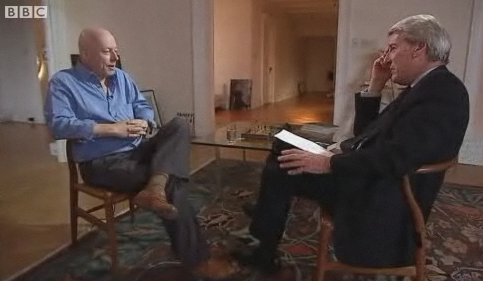
Christopher Hitchens talks to Jeremy Paxman about his cancer, his life, ideas & the conflict between Religion & The Enlightenment

source: BBC iPlayer until 6th December 2010. First broadcast on BBC Two, 7:30pm Mon, 29 Nov 2010.

Part 1
http://www.youtube.com/watch?v=FwDYbNIHyN0

Part 2
http://www.youtube.com/watch?v=4DpUeKwleyw


On Cancer & A Life well lived
Christopher Hitchens talks about his cancer (1'5"-1'45"), living day-to-day (1'50"-2'10"), are you terrified of dying of cancer? (2'10"- 3'40"), the pathetic fallacy (3'40-4'35"), does it make you angry? (4'35"- 6'30"), how do you think about life now? (6'30"- 7'30"), Pascals Wager (22' 15"- 25' 30"), do you fear death? (25'30-27'), has it been a life well lived? (27'- 29')

Why Criticism of Religion is Important
What would you like to see & do with the rest of your life? (7'30"-8'5"), why criticising Mother Teresa was important (10'-11'20"), Iraq (12'-14'), conflict between West & Islamofaschism (19'20"-20'20"), conflict between theocracy /totalitarianism & The Enlightenment / freethought (20'20"-21'30"), The Bible, Koran & Torah - works of man made (not divine) fiction (21' - 21'30"), mockery of religion (21'30"-22'15")

Jeremy Paxman

Christopher Hitchens

Friday, November 16, 2007

Religion - A dangerous delusion by Sue Blackmore

reposted from: http://commentisfree.guardian.co.uk/sue_blackmore/2007/11/a_dangerous_delusion.html
Chris Street comments are in bright green; highlights in blockquotes (yellow).

also see "Gott und Gen" - Basel, February 2007: The God Meme - Why Faith is So Infectious


Sue Blackmore

A dangerous delusion

By thinking of religion in terms of evolutionary theory we can see just how and why the major religions of today are so harmful

November 13, 2007 11:00 AM

Tonight, at a debate at Bristol University, I've been asked to propose the motion that "belief in God is a dangerous delusion". Oxford theologian Alister McGrath will fight back and argue that it is not. By putting some of my thoughts up here I hope some of you may help me anticipate the flack to come, and since the thread should still be open afterwards, I can report back on what happened.

Belief in God is certainly a delusion but is it dangerous? Perhaps the organisers chose that word only because of the nice alliteration. Perhaps they might have said "harmless" or "quaint" or even "beneficial", but no, I think they are right. Belief in God is dangerous.

First, which God am I talking about? Not Einstein's God, the God of the deists, or what Stephen Hawking or Paul Davies refer to as "the mind of God," for their God amounts to the entirety of the universe, or the laws of physics. If you ask "why is there something rather than nothing?" or "what came before the big bang?" and you answer "God", belief in that God makes no difference to your daily life, or to morality and responsibility, nor does it cause people to band into groups, exclude outsiders, commit atrocities or justify wars.

No,

I'm talking about the God of the great monotheistic religions, the vile and vengeful God of the Qur'an and the Old Testament,
the God who supposedly made us in his own image, who answers prayers even though the world remains full of suffering, who exhorts us to love and feel compassion while threatening to kill the infidel and punish the unbeliever forever, and who fights on both sides of every war.

Belief in this kind of God is dangerous indeed, but I suspect its danger is different for individuals than for whole societies. For a single individual, living in a generally unbelieving or secularist, tolerant, and open society, belief may be a good thing - for that person. In times of fear, loneliness or bereavement, it's nice to believe that there's someone powerful out there who knows you deeply and cares what happens to you. When difficult choices loom, it helps to think there's a guiding hand. I suspect that for many of the 40% of Britons found in a survey last week to pray regularly, their God fills this role.

We know that most of them do not go to church or worship regularly, and they probably do not take on board much of what is required of a committed Christian or Muslim. In other words they feel free to believe in a God of their own choosing. Surely there's no harm in this is there?

Maybe not, but

as Sam Harris argues, in The End of Faith, moderate believers like this implicitly encourage the idea that faith is something to be respected - that it's all right to believe in completely ludicrous things for which there is no evidence. And this in turn encourages religious faith, which is where the real dangers begin.

You may have noticed an analogy here with game theory in biology, where what is good for the individual is not necessarily good for the group or the species. For example, there can be species in which most individuals behave altruistically towards each other and so benefit the whole group. But then it pays individuals to cheat and take the benefits without paying their way to everyone else. The result can be the complete elimination of the altruistic behaviour, or else a settling down into a stable state in which the wider group fights back but tolerates a certain proportion of freeloaders.

This is just an analogy, but there are good reasons for thinking of religions in terms of evolutionary theory - although in terms of cultural, or memetic evolution rather than biological. This way we can see just how and why the major religions of today are so horribly dangerous.

There has long been dispute between believers who claim that their particular religion was created by God and that their holy book (whichever one it might be) is "the word of God," and those who say that religions are man-made. Scholarship and historical and archaeological research naturally support the latter, but

I'd rather forget that distinction and not think about religions as having been made up by particular individuals, but as having evolved over long periods of time, using lots of people as their copying and selecting machinery.

This way of thinking means inverting our normal way of thinking about ourselves and, to use Richard Dawkins's term, taking the meme's-eye view. Just as biologists have found it useful to take the gene's eye view -

asking why and how this particular gene has survived - so we can look at religions as vast cooperating systems of memes, and then ask why this meme survived. Why are these words, stories, songs, artefacts, practices, clothes and rituals here today in Christianity, in Islam, in Judaism? Not because God gave them to us, not because someone or some group of people deliberately put them together to make a religion, but because they, the memes, the bits and pieces of behaviours and practices, out-competed their rivals to pull through over thousands of years and still lodge themselves in people's brains today.

Think of the times in which the great religions began, indeed think of much of the centuries since. All over the world, in villages, towns, or in great city states, there would appear epileptics who saw visions,

fascinating visionaries, charlatans who worked miracles by trickery, orators of great skill and persuasiveness, and all sorts of other types who would collect around them small groups of followers. They still appear today and form cults that thrive for a while, and then usually die out. Human nature being what it is, their members want their own group to grow, and so bring in their friends, and persuade others that they have the answer to life's miseries and mysteries, or that they are superior to outsiders.

sounds like the School of Economic Science - Chris Street

Different groups adopt different practices. Some of these routines, ways of talking, rituals, markers or special clothes prove attractive to people and so flourish and spread. Ineffective practices and beliefs fizzle out. This is just a simple evolutionary process - competition for survival - only the competition is between beliefs, practices, stories and habits to get lodged in human brains and passed on. Indeed it is a competition between beliefs to take over human copying machinery and make it work to spread those beliefs.

As the competition gets fiercer, free floating beliefs fail to compete. The ones that succeed are more like organisms that protect themselves and use tricks and clever adaptations to ensure their survival and propagation. And so they build up in complexity. This is, I suggest, the right way to understand how we got the religions we have today.

When you see religions as mind viruses that evolved over thousands of years in competition with other, similar, mind viruses, it's easy to see why they have acquired the powerful adaptations they have. Just as animals acquired teeth and claws, beaks and jaws, mimicry and trickery, so religions have acquired their own weapons and tricks. They protect themselves with threats and promises - and not just any old threats and promises. Some are promises of everlasting pain or eternal bliss - only you can't check whether they're true because you'll only find out after you're dead. Others are immediate threats that can be checked - that if you reject a belief you never chose in the first place but were landed with as a baby, you'll be killed. And this is happening even here in Britain. The founder of the Council of Ex-Muslims of Britain has had numerous death threats for trying to help Muslims let go of their imposed beliefs.

Then there are subtler adaptations - what about claiming natural human mystical experiences as religious experiences or visions of God? Or claiming that morality comes from God rather than from human nature, so undermining people's confidence in their own moral decisions. Believers frequently claim that rejecting belief in God would lead people to immorality, murder and mayhem. What little research there is so far suggests quite the reverse. A recent study comparing developed nations showed that the more religious nations also had higher rates of murder, suicide, teenage pregnancy and violent crime - precisely those behaviours that most religions prohibit.

A really clever trick - and I'm not sure how the great religions have managed to pull this one off - is to make the rest of us feel that we ought to respect people for believing impossible things on faith, and that we should not laugh at them for fear of offending them. In a society that strives for honesty and openness, that values scientific and historical truth, and that encourages the search for knowledge, this is outrageous - and it's scary that we still fall for it.

Then there's the cost of believing. Many are tempted by Pascal's Wager: if I deny that God exists and I'm wrong, oops I might really go to hell, but if I believe in him and I'm wrong there is no problem. But there is a problem - the enormous cost of belief.
There is not only the mental and intellectual burden of having to take on false, disturbing and incompatible beliefs, but the cost in time and money. Religious memes capture people's time to get themselves spread. Just as the common cold virus makes people sneeze to get itself spread, so religions make people sings hymns and say prayers, and chant and so spread the word of God. They also induce them to part with large sums of money to build glorious mosques, churches and synagogues and to pay the wages of priests who in turn spread the word of God.

And how did they get this way? They got this way because less effective versions of the religions, with less dangerous tricks and weapons, failed to infect enough people.

That is why belief in God is not just a harmless choice; it is a dangerous delusion.


GBR

Obviously this perennial topic still excites people. The Great Hall was full (approx 900 people) and apparently another 150 were turned away. I said something similar to what I wrote here, and then Alister McGrath spoke about his early career as an atheist scientist, the reasons he turned to Christianity, and how now he sees the world as making far more sense when viewed through the eyes of a believer. But I don't think I ever grasped why or how the world makes more sense this way.
He criticised the memes concept and talked about how God brings about inner transformation, joy, and "life in all its fullness". To that I responded that those experiences, as well as profound mystical experiences, are common to us all. You don't need God to experience life in all its fullness!
Questions came thick and fast for nearly an hour, and informally two votes were taken, one roughly coincided with belief in God, to which perhaps a quarter raised their hands, then at the end the chairman, Kathy Sykes, asked who agreed that God is a dangerous delusion. Around a fifth to a quarter agreed.

So it seems that most don't believe in God but neither do they think belief is a dangerous delusion.

In the melee afterwards, some people praised the debate for being good humoured and balanced. Others complained "You were too polite. You should have torn them apart."
I'll leave this to

Logistikon who said

I was there tonight and am so annoyed I didn't have the courage to go up and challenge McGrath.

McGrath, after damning fanaticism itself and asking 'what is it's origin? said that his belief in God was like 'belief in the sun coming up, but that it is not that the sun 'comes up' but that 'by it one sees everything''

"By it one sees everything" What????

Thursday, October 25, 2007

Debate Points at RichardDawkins.net

reposted from: http://richarddawkins.net/article,1781,n,n
Chris Street comments are in bright green; highlights in blockquotes (yellow).

A new website addition: Debate Points

by RichardDawkins.net

I thought we might try a new section here at RichardDawkins.net called "Debate Points". A lot of people have mentioned that we need to stay on top of the arguments for and against the debate points we will meet. Some seem to never die (Hitler/Stalin, Morality), and we can always improve our arguments. Let's use the comment space on this post to brainstorm some points that we can start discussions on. We can then use the Debate Points category to list some of these, and users can post their thoughts or rebuttals in the comment space. Let's try and be clear and concise, as if these were to be used in a real debate. For example, what would you say if you were to debate Dinesh D'Souza in front of a Christian College?

The link to the Debate Points area is:
http://richarddawkins.net/debatepoints
( <-- I've also placed a link to it in the left column )

Here are some we can start with (click on each topic to go to its own thread):

Arguments Against Evolution

Hitler, Stalin, Mao, etc. were atheists, and they were terrible!

You can't be moral without God!

Religion is not incompatible with Science: 'Non-Overlapping Magisteria'

Atheism is a religion and you're as bad as the fundamentalists

That's not MY God you're criticising

Science and Religion BOTH make faith claims

I Don't Have Enough Faith to be an Atheist

A Rational Universe Implies a Creator, Science points towards Theism

Pascal's Wager

Arguments From Design, First Cause, Something Rather Than Nothing, Fundamental Constants

You can't prove that you love someone, so don't expect proof of God

Science can answer how questions but only religion can answer why questions

If you don't accept the supernatural, you obviously think life is depressing, meaningless and cold

The Transcendental Argument for God

So what other common debate points can you think of? Please list them below!

Thanks,
Josh

Wednesday, September 05, 2007

PASCAL’S WAGER - there are no rational grounds available to settle whether the Christian faith is true or false.

reposted from Stephen Law
PASCAL’S WAGER

[taken from my forthcoming book for Quercus, Greatest Philosophers, out next month (and which, in my opinion, is a bargain at under £6 for a 200+ page, larger format, illustrated book. In fact I'm not sure it isn't too cheap.)]


According to Pascal, there are no rational grounds available to settle whether the Christian faith is true or false. Reason cannot settle the matter one way or the other. So should we believe, or not?

Pascal suggests we approach this question as if it involved placing a bet. We have two options: we can believe, or we can fail to believe. What do we stand to win or lose in each case?

Well, if I believe, and there is a God, then I win big. My reward will be eternal happiness. But what if there is no God? Then obviously I won’t receive that fantastic reward. But still, my loss is not so very great. Little more than those Sunday mornings I had to spend in church.

If, on the other hand, I fail to believe in God, and God exists, I lose big, for I face eternal damnation. Nothing could be worse. And if I fail to believe in God, and there is no God, then I win, but then I don’t win very much. Not much more, in fact, than those free Sunday mornings.

We can display these outcomes in a table, like so:

-------------------------------God exists-------------God does not exist

Believe in God-------------eternal bliss-----------small loss of worldly pleasures

Fail to believe in God-----eternal damnation---small gain in worldly pleasures

Now, assuming that we have no more grounds to suppose God does exist than to suppose he doesn’t, surely the rational bet to make is to believe in God. If I believe, then I will either win big or lose a little. If I fail to believe, then I either win small or lose big. Belief is therefore the more sensible wager, concludes Pascal.

Pascal claims belief in God is the rational choice even though there are no more grounds for supposing the belief is true than there are for supposing it is false. His claim sounds paradoxical, but, correctly understood, it is not. Consider an analogous case. You are diagnosed with a disease that will certainly soon kill you unless you receive treatment. There is only one treatment, and it has a 50% success rate. When the treatment doesn’t work, its side-effects are rather unpleasant. What should you do?

Clearly, the rational choice, assuming you want to live, is to undergo the treatment, despite the fact that you have no more grounds to suppose it will work than you have to suppose it won’t. Undergo the treatment and you will either win big or lose little. Fail to undergo the treatment, and you will either lose big or win small.

If Pascal is correct, the option of believing in God is similarly one it would be irrational not to embrace.

Objections to Pascal’s argument

Many have found Pascal’s argument persuasive, but it does run up against some well-known objections, including the following:

1.
We cannot choose what we believe.
First, some will respond, “But I can’t just choose to believe that God exists. It may be that, though I can see that belief in God is the rational bet, and so would very much like to believe it, I can’t manage it. Try as I might, belief eludes me.” Pascal acknowledges that we can’t usually choose what we believe. Certainly we can’t just make ourselves believe something directly, by a sheer act of will. However, he notes that even those who merely start off by going through the motions of religious belief often end up true believers. So if I also make myself go though the motions – if I regularly go to church and pray – I am likely to end up a true believer. This is exactly what Pascal recommends I should do.

2. Pascal’s wager is based on a dubious assumption.
Pascal supposes that the arguments and evidence for and against God’s existence are evenly balanced. But are they? Most atheists would deny this. Many would say the arguments and the evidence overwhelming support the claim that there is no God. If they are right about that – if, say, the odds of God existing are not 50-50, but more than 99-1 against – then it is not quite so obvious that belief in God is the rational bet.


To illustrate, let’s return to the medical example outlined above. If you are told the probability that the treatment will succeed is not 50%, but much less than one percent, then it is not so clear that the rational choice is to opt for treatment. Especially as you know that you will almost certainly experience some nasty side-effects as a result. Under these circumstances, you might well calculate that you would be better off rejecting treatment.

3. Another dubious assumption.
Third, we might question whether Pascal is right to assume all believers will be rewarded with eternal bliss and all disbelievers with eternal damnation.
If I was God, I wouldn’t be particularly impressed by someone who believed in me purely on the basis of a self-interested calculation. Nor, if I had deliberately arranged the evidence for my existence to be equivocal, would I condemn to eternal agony someone who then failed to believe in me. Such punishment seems rather harsh, particularly from a God who is supposed to be supremely benevolent.

So Pascal’s estimation of how God, if he exists, will react to our belief or disbelief – that he will reward all believers with limitless bliss and punish all unbelievers with an eternity of hellfire – is certainly open to question.