Pages

Showing posts with label astronomy. Show all posts

Sunday, May 04, 2008

the total number of stars in the universe is greater than all the grains of sand on all the beaches of the planet Earth. (Carl Sagan). Correct?

I use a rule of thumb that the total number of galaxies in the universe as 100 billion (10 power 11) and the average number of stars in each galaxy as 100 billion. Total number of stars in the Universe (10 power of 22 or 1 with 22 zeros following it) or 10,000,000,000,000,000,000,000. This is similar to the figure that Glen Mackie calculates (just 5 times that number!).

Link via http://en.wikipedia.org/wiki/Galaxy#cite_note-6 (accessed 4th May 2008).

To see the Universe in a Grain of Taranaki Sand

Glen Mackie

[appeared in North and South magazine, May, 1999]

It had worried me for a long time. I could hear his voice,

... the total number of stars in the universe is greater than all the grains of sand on all the beaches of the planet Earth.

NGC 1850 by WFPC2/HST I heard Carl Sagan repeating those words again recently when I looked along a surf beach on the Taranaki coast. Later that evening I looked up at the sky. We are fooled somewhat. Our eyes can only resolve about 5000 of the brightest stars, mostly close to our Sun, and typically within 1000 light years (1 light year is the distance light, travelling with a velocity of 300,000 kilometres per second, covers in 1 year).


From left, Alpha and Beta Centauri, dark Coal Sack nebula, Southern Cross (Beta Crux, Alpha Crux  (blue-ish), Gamma Crux (orange), Delta Crux), Eta Carinae nebula (large pink blob). Our Galaxy however, is probably greater than 100,000 light years in diameter. Hence we can resolve only a very small fraction of our Galaxy with our eyes. As well, whilst our view of the brightest stars is a magnificent panorama we do not get any sense of depth or relative distances of stars. For example, the two bright stars close together, alpha and beta Centauri, (commonly called The Pointers because they guide us to the nearby Southern Cross) are at very different distances. Rigil Kentaurus and Hadar (their common names) are 4.3 and 490 light years distant, respectively. Hardly neighbours!

The faint smudge of light we call the Milky Way, easily visible on a dark night, is millions of very faint, distant stars lying in the disk of our Galaxy that our eyes cannot resolve. Dark clouds of dust (microscopic pieces of carbon and silicon) dimms the light of many more stars. Apart from a few neighbouring galaxies (including the Large and Small Magellanic Clouds visible in the southern sky), that appear as faint, fuzzy blobs of light, our naked eye perception of the universe is very myopic.

My feet stood on what seemed to be an unfathomable number of sand grains on that wide, long Taranaki beach. If sand grains were stars, a handful of sand thrown into an empty sky could easily replicate what we see. Imagine the brilliant sky you could create with a whole beach of sand! The voice returned. Carl was probably right. He would have done the calculation. Doubts remained though, and I knew it was time to put his voice to rest.

I knew some average numbers for stars and galaxies. In many astronomical studies an answer to within an order of magnitude (a factor of 10) is deemed acceptable. Since I had a funny feeling that an average beach may also be hard to describe, I decided to accept order of magnitude accuracy.

Messier 31 in Andromeda

Our Galaxy, has approximately 400 billion stars. Carl used this number in the book based on his Cosmos television series and I'll stick with it.
We define a billion as 10 to the power 9, or 1 with 9 zeroes following it, ie. 1,000,000,000. Big. Is our Galaxy average? Well, it's a spiral, a little less massive than our magnificent Local Group neighbour, Messier 31 in Andromeda. As far as spirals go, it's probably close enough to average. The other galaxies that exist in the universe, large ellipticals and smaller irregular galaxies, tend to have more and less stars, respectively. I'll assume that, in terms of star numbers, our Galaxy represents the average galaxy.

What is the total number of galaxies in the universe?
Sagan assumed 100 billion.
Is that still valid? Recently the Hubble Space Telescope (HST) surveyed, to the faintest levels yet detected, a small area of sky. Extrapolating from the number of galaxies detected by HST to that expected over the whole sky, I calculate 130 billion galaxies, slightly larger than Sagans estimate.
Then the number of stars in the universe is 400 billion x 130 billion, or about 50,000 billion billion. A billion billion. That's 1,000,000,000,000,000,000. So, grasp the concept of a billion billion, then think of 50 thousand of those. Easy! - 50,000,000,000,000,000,000,000.

What are the dimensions of an average, sandy beach on Earth? I was lucky. I know a Coastal Geomorphologist (doesn't everyone?) who provided some estimates. Take 360,000 kilometres of coast (the total coastline of the world is about 1 million kilometres, of which about 36 percent is sandy), mix with an average beach width of 50 metres (high to low tide lines), and add a dash of average beach depth of 4 metres.

The diameters of sand grains range from about 0.1 to 2 millimetres. We'll adopt an average diameter of 0.5 millimetres. Lets stack them simply, one on top of another (not very likely in a beach I admit), so that 8000 fit into 1 cubic centimetre. Drum roll please. The total number of sand grains on our Earth beach is then 600 billion billion. But wait!, I hear some of you remarking about sand dunes and sand below the low tide mark. To placate you worriers I'm happy to increase my initial estimate by a factor of 3. That gives me a grand total of about 2000 billion billion grains of sand on Earth.

The stars win! Carl was right, ... maybe. The excess factor (the number of stars divided by the number of grains) of 50,000/2000 or 25 is greater than an order of magnitude, but only just. My individual assumptions must be wrong at some level. Maybe the average galaxy has only 40 billion stars (faint surveys do detect many small, ``dwarf'' galaxies). As well, maybe the number of sand grains is three times greater. (In fact my Coastal Geomorphologist suggested that the average grain diameter could be smaller than 0.5 millimetres, probably allowing us to stack a factor of 3 more!). Combine these two changes and the grains win, just!

Hubble Deep Field South by NICMOS/STIS/HST

Not so fast! Any (conspired) increase in the number of sand grains is probably offset by the recent discovery of many more galaxies by HST in the near-infrared region of the electromagnetic spectrum, not previously detected in optical surveys. Observing in the infrared minimizes the absorbing effects of dust allowing us to see galaxies enshrouded in large amounts of dust present because of vigorous star formation. The odds are that there are many more than 130 billion galaxies in the universe. I'll cast my final vote in favour of the stars, and I'll admit a slight astronomical bias (see author notes).

I returned home after three days of travelling. I could now stand on a beach and not hear Carl Sagans voice. I had even warmed to the number billion. For example, whilst I was away during those three days, our Galaxy had moved another 0.2 billion kilometres towards the Virgo cluster of galaxies (located 650 billion billion kilometres away), and the population of New Zealand had experienced 1,600 billion heartbeats. Now, is that resting heartbeat? Here we go again.


Carl Sagan (1934-1996) was Director of the Laboratory for Planetary Studies and David Duncan Professor of Astronomy and Space Sciences at Cornell University. Professor Sagan was a leading popularizer of science and astronomy in particular, and presented the Cosmos television series and wrote the book (Cosmos, Random House: New York) based on the series.

Glen Mackie is Lecturer, in the Centre for Astrophysics and Supercomputing, Swinburne University of Technology, Melbourne, Australia.


Last updated February 1, 2002


Sunday, December 16, 2007

Russells Flying Teapot - Found?

reposted from: http://antwrp.gsfc.nasa.gov/apod/astropix.html
Chris Street comments are in bright green;
highlights in yellow blockquotes.

Astronomy Picture of the Day

2007 December 16

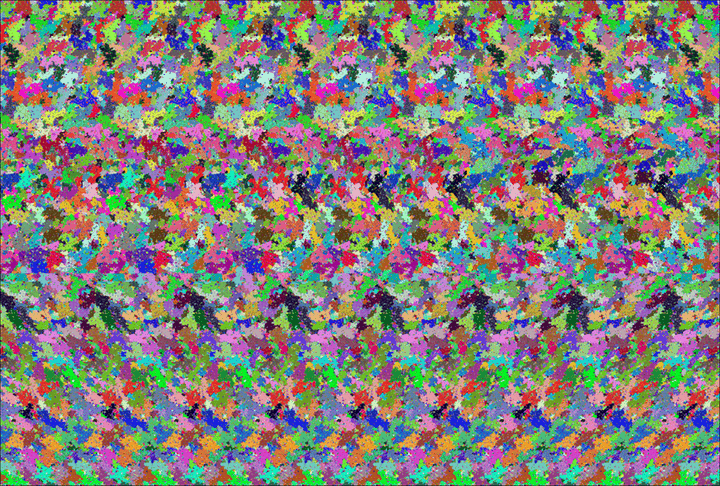
Click on the picture and stare at it for a minute or so!! What do you see??

See Explanation.  Clicking on the picture will download  the highest resolution version available.


The Holographic Principle
Image Credit & Copyright: E. Winfree, K. Fleischer, A. Barr et al. (Caltech)

Explanation: Is this picture worth a thousand words? According to the Holographic Principle, the most information you can get from this image is about 3 x 1065 bits for a normal sized computer monitor. The Holographic Principle, yet unproven, states that there is a maximum amount of information content held by regions adjacent to any surface. Therefore, counter-intuitively, the information content inside a room depends not on the volume of the room but on the area of the bounding walls. The principle derives from the idea that the Planck length, the length scale where quantum mechanics begins to dominate classical gravity, is one side of an area that can hold only about one bit of information. The limit was first postulated by physicist Gerard 't Hooft in 1993. It can arise from generalizations from seemingly distant speculation that the information held by a black hole is determined not by its enclosed volume but by the surface area of its event horizon. The term "holographic" arises from a hologram analogy where three-dimension images are created by projecting light though a flat screen.

Beware, other people looking at the above image may not claim to see 3 x 1065 bits -- they might claim to see a teapot.


Tuesday, October 09, 2007

Aurora, Stars, Meteor, Lake, Alaska


reposted from: http://antwrp.gsfc.nasa.gov/apod/astropix.html

Astronomy Picture of the Day

Discover the cosmos! Each day a different image or photograph of our fascinating universe is featured, along with a brief explanation written by a professional astronomer.

2007 October 9

Aurora, Stars, Meteor, Lake, Alaska
Credit & Copyright: Bud Kuenzli

Explanation: Sometimes, after your eyes adapt to the dark, a spectacular sky appears. In this case, a picturesque lake lies in front of you, beautiful green aurora flap high above you, brilliant stars shine far in the distance, and, for a brief moment, a bright meteor streaks by. This digitally fused breathtaking panorama was captured late last month across one of the Chena Lakes in North Pole, Alaska, USA, and includes the Pleiades open cluster of stars on the image right. The shot is unusual not only for the many wonders it has captured simultaneously, but because lakes this far north tend to freeze and become non-reflecting before a sky this dark can be photographed.

Sunday, September 30, 2007

Astronomy Picture of the Day - Milky Way


reposted from:

Astronomy Picture of the Day

Discover the cosmos! Each day a different image or photograph of our fascinating universe is featured, along with a brief explanation written by a professional astronomer.

2007 September 30
A Milky Way Band
Credit & Copyright: John P. Gleason, Celestial Images

Explanation: Most bright stars in our Milky Way Galaxy reside in a disk. Since our Sun also resides in this disk, these stars appear to us as a diffuse band that circles the sky. The above panorama of a northern band of the Milky Way's disk covers 90 degrees and is a digitally created mosaic of several independent exposures. Scrolling right will display the rest of this spectacular picture. Visible are many bright stars, dark dust lanes, red emission nebulae, blue reflection nebulae, and clusters of stars. In addition to all this matter that we can see, astronomers suspect there exists even more dark matter that we cannot see.

Saturday, September 15, 2007

Saturn moon Cassini - huge ridge


reposted from: http://antwrp.gsfc.nasa.gov/apod/astropix.html

Iapetus: 3D Equatorial Ridge
Credit: Cassini Imaging Team, SSI, JPL, ESA, NASA
Stereo Anaglyph: Patrick Vantuyne

Explanation: This bizarre, equatorial ridge extending across and beyond the dark, leading hemisphere of Iapetus gives the two-toned Saturnian moon a distinct walnut shape. With red/blue glasses you can check out a remarkable stereo composition of this extraordinary feature -- based on close-up images from this week's Cassini spacecraft flyby. In fact, the ridge's combination of equatorial symmetry and scale, about 20 kilometers wide and reaching up to 20 kilometers above the surface, is not known to be duplicated anywhere else in our solar system. The unique feature was discovered in Cassini images from 2004. It appears to be heavily cratered and therefore ancient, but the origin of the equatorial ridge on Iapetus remains a mystery.

Tuesday, September 11, 2007

A Scorpius Sky Spectacular


reposted from: http://antwrp.gsfc.nasa.gov

A Scorpius Sky Spectacular
Credit & Copyright: Stéphane Guisard

Explanation: If Scorpius looked this good to the unaided eye, humans might remember it better. Scorpius more typically appears as a few bright stars in a well known but rarely pointed out zodiacal constellation. To get a spectacular image like this, though, one needs a good camera, color filters, and a digital image processor. To bring out detail, the above image not only involved long duration exposures taken in several colors, but one exposure in a very specific red color emitted by hydrogen that brings out great detail. The resulting image shows many breathtaking features. Vertically across the image left is part of the plane of our Milky Way Galaxy. Visible there are vast clouds of bright stars and long filaments of dark dust. Jutting out diagonally from the Milky Way in the image center are dark dust bands known as the Dark River. This river connects to several bright stars on the right that are part of Scorpius' head and claws, and include the bright star Antares. Above and right of Antares is an even brighter planet Jupiter. Numerous red emission nebulas and blue reflection nebulas are visible throughout the image. Scorpius appears prominently in southern skies after sunset during the middle of the year.

Friday, August 31, 2007

Water pours on young star system

reposted from bbc
Water pours on young star system
Nasa's Spitzer Space Telescope detected large amounts of water in the disc

A torrent of water-ice cascading down on an embryonic star system may shed light on how a key ingredient for life makes its way into planets.

Writing in Nature journal, astronomers detected enough water vapour to fill Earth's oceans five times over in the collapsing nest of a young star system.

Ice pours down from the outer envelope of this forming star, vapourising as it hits the dusty disc where planets form.

The team based its findings on data from Nasa's Spitzer Space Telescope.

"For the first time, we are seeing water being delivered to the region where planets will most likely form," said lead author Dan Watson of the University of Rochester in New York, US.

The young star system, called NGC 1333-IRAS 4B, is still growing inside a cool cocoon of gas and dust.

Within this cocoon, a warm disc of planet-forming materials circles the embryonic star.

Supersonic travel

The data indicates that ice from the stellar embryo's outer cocoon falls towards the forming star at supersonic speeds and vaporises as it hits the proto-stellar disc.

"On Earth, water arrived in the form of icy asteroids and comets. Water also exists mostly as ice in the dense clouds that form stars," said Professor Watson.

NGC 1333   Image: Nasa/JPL-Caltech
The embryonic star is located in the planet forming region NGC 1333
"Now we've seen that water, falling as ice from a young star system's envelope to its disc, actually vaporises on arrival.

"This water vapour will later freeze again into asteroids and comets."

By analysing what is happening to the water in NGC 1333-IRAS 4B, the astronomers can learn more about its planet-forming disc.

The team calculated a density for the disc of at least 10 billion hydrogen molecules per cubic centimetre (160 billion hydrogen molecules per cubic inch).

Its dimensions could also be calculated - the disc has a radius bigger than the average distance between Earth and Pluto. The researchers also determined its temperature was -103C (-154F; 170 Kelvin).

Studying planet-forming discs at this early stage of development could determine which of two competing theories of planet formation is correct.

Nasa's Spitzer infrared telescope

In the core accretion model, planets form little by little, as material slowly congeals within the disc over millions of years.

The disc instability model suggests that turbulence in the disc can cause matter to collapse into planets extremely quickly, forming Jupiter-like planets in just thousands of years.

NGC 1333-IRAS 4B is located in a star-forming region about 1,000 light-years away in the constellation Perseus.

Its central stellar embryo is still "feeding" off the material collapsing around it and growing in size. Astronomers cannot yet tell how large the star will ultimately become.


Friday, August 24, 2007

Great 'cosmic nothingness' found

reposted from BBC

Great 'cosmic nothingness' found
VLA (NRAO/AUI)
The result comes from a sky survey by the VLA in New Mexico

Astronomers have found an enormous void in space that measures nearly a billion light-years across.

It is empty of both normal matter - such as galaxies and stars - and the mysterious "dark matter" that cannot be seen directly with telescopes.

The "hole" is located in the direction of the Eridanus constellation and has been identified in data from a survey of the sky made at radio wavelengths.

The discovery will be reported in a paper in the Astrophysical Journal.

Previous sky surveys that have traced the large-scale structure of the nearby Universe have long shown, for example, how the clustering of galaxies is strung into vast filaments and sheets that are separated by great gaps.

But the void discovered by a University of Minnesota team is about 1,000 times the volume of what would be expected in typical cosmic gaps.

"It's hard even for astronomers to picture how big these things are," conceded Minnesota's Professor Lawrence Rudnick.

"If you were to travel at the speed of light, it would take you several years to get to the nearest stars in our own Milky Way galaxy; but if you were to go to this hole and enter one side, you'd have to travel for a billion years before you would get to the other side," he told BBC News.

The void is roughly 6-10 billion light-years away and takes a sizeable chunk out of the visible Universe in its direction.

Dark evidence

The team used data from the US National Radio Astronomy Observatory's VLA Sky Survey (NVSS) to make its discovery. The VLA - which stands for Very Large Array - is a collection of 27 radio telescopes in New Mexico.

The finding is said to fit neatly with observations of the Universe's "oldest light" - the famous Cosmic Microwave Background (CMB) radiation, the study of which has earned several scientists the Nobel Prize.

This is the radiation that comes from just 380,000 years after the Big Bang when the Universe had cooled to such a degree that hydrogen atoms could exist. Before that time, scientists say, the Universe would have been so hot that matter and light would have been "coupled" - the cosmos would have been opaque.

THE CMB - OLD AND COLD
CMB (Rudnick et al., NRAO/AUI/NSF, NASA)
Nasa Probes have mapped the Cosmic Microwave Background which is all around us in space
This radiation from the infant Universe shines at weak radio (microwave) wavelengths
The maps show up tiny temperature fluctuations - the mottled colours above
These fluctuations correspond to the early distribution of matter in the fledgling cosmos
Nasa's WMap satellite sees a cold spot lying in the path of the newly found void

Today, this light shines at microwave wavelengths at a frigid -270C; and observations of the CMB made by Nasa's Wilkinson Microwave Anisotopy Probe show a particular "cold spot" in the direction of the newly identified void.

The explanation for this may lie in the enigmatic "dark energy" that scientists know so little about but which is said to be accelerating the expansion of the Universe.

Light particles passing through the void would be expected to lose a little more energy than those passing through space cluttered with matter - if dark energy is stretching the Universe apart at a faster and faster rate.

Scientists refer to this as the Integrated Sachs-Wolfe Effect and a corresponding "warm spot" in the CMB associated with an area of space dominated by a supercluster of galaxies was identified some years ago.

"In essence, this latest study gives us a very elegant demonstration of the existence of dark energy in a way which is very convincing," commented Professor Carlos Frenk, the director of the Institute for Computational Cosmology at Durham University, UK.

"We keep getting evidence for dark energy, this component of the Universe which is so dominant, and yet we still have only a tiny glimmer of what it could be."

The reason the void exists is not known. "That's going to be a challenge for people that work on the development of structure in the Universe. It's a very hot topic in the cosmology right now," said Professor Rudnick.


SEE ALSO
Satellite prepares to go super-cold
04 Feb 07 | Science/Nature
'Ancient light' takes Nobel Prize
03 Oct 06 | Science/Nature
Sky surveys reveal cosmic ripples
12 Jan 05 | Science/Nature
Map reveals strange cosmos
03 Mar 03 | Science/Nature

RELATED INTERNET LINKS

Saturday, July 21, 2007

Infrared Andromeda


Explanation: This wide, detailed Spitzer Space Telescope view features infrared light from dust (red) and old stars (blue) in Andromeda, a massive spiral galaxy a mere 2.5 million light-years away. In fact, with over twice the diameter of our own Milky Way, Andromeda is the largest nearby galaxy. Two smaller companion galaxies, NGC 205 (below) and M32 (above) are also included in the combined fields. The data confirm that Andromeda (aka M31) houses around 1 trillion stars, compared to 4 hundred billion for the Milky Way.