Pages

Showing posts with label NSS - affiliation by DH. Show all posts

Sunday, January 06, 2008

Religion in schools – long overdue for a radical rethink by Terry Sanderson

It seems the issue of "faith schools" is not going away – however much the Government would like it to. The NSS is doing its best to keep this vital subject on the boil and in the public eye. The most recent example of this was when we drew the attention of the Observer to an outrageous document published by the Catholic bishop of Lancaster, Patrick O'Donoghue, which he sent to all Catholic schools in his diocese. The bishop, it seems, wants to introduce a Taliban-style regime of Catholic orthodoxy in his diocese's schools.

reposted from: Newsline 4th Jan 2008
Chris Street comments are in bright green;
highlights in yellow blockquotes.

You can read what the Observer made of the story and the bishop's gob-smacking demands.

We have been told continually by the churches and the Government that "faith schools" are not about indoctrination and are not primarily about proselytising. The Lancaster document, with its revealing title, Fit for Mission, tells a different tale.
Fit for Mission? Is that what our schools have become – "missioning" grounds for failing religion?
It is time that the Government told the churches that it will no longer collude in the promotion of religion at public expense in this way. It is time for Ed Balls to do what other education ministers have not had the guts to do – tell the Archbishops and the bishops that their time is up in schools.

But how are we to overcome the very successful barrage of propaganda that the churches and mosques put out about how important a sense of morality is in schools – a sense of morality which, of course, only they can provide? How are we to challenge the deeply ingrained idea that religion is vital for children? Why does it seem so radical — even revolutionary — to suggest that, actually, children can have a perfectly adequate education without the input of priests, imams and vicars? They manage quite well in America and France without such interference in the education system.

The time has come for us to leave behind the idea that it is OK for religion to be pushed and promoted in schools so long as "humanism" or "atheism" gets a mention along the way. But it is not OK. It is far from OK.

We should stop asking for crumbs from the table and demand instead a neutral space in which children can learn without competing ideologies trying to use schools to recruit new members. But while the humanist movement continues to go along with the idea that it is important to educate children about religion in our state schools, the clerics will always be on hand to ensure it is done their way. And whatever small concessions they might make to "critical input from non-religious standpoints" it will always be they who have their hands on the steering wheel.

If we are to have religious education in schools at all (and, personally, I see no need for it), then it should be taught as an academic subject in short courses created by independent academics, not by agenda-pushing evangelists.
As well as dismantling the "faith school" system, we need to get the churches, temples and mosques out of our schools completely and allow children to have a well-rounded, propaganda-free education that lets them reach their own conclusions.
At the moment, it starts in primary school with a contentious premise (religion is good and, indeed, essential for a person to function in the world) and then, throughout the whole of their school life, religious education will be on hand to reinforce that idea for children. Anyone who has read the religious education framework will know that it is a charter for indoctrination – it is unbalanced, partisan and makes only the most grudging allowances for religions other than Christianity, and humanism gets only a fleeting mention.


Religious establishments and institutions in this country are at full liberty to preach their messages and to seek converts. But the converts must be free agents who have made the decision to embrace the faith without pressure and coercion. That is not the case in Britain's schools. Children are not given the option of saying: "I don't believe this and I don't want to have anything to do with it" as they might be about political opinions and other contentious matters.
No. Unless they get parental permission (or sixth form self-withdrawal), they are forced — by law — to take part in worship. Not just to attend it, but to take part in it. In any other circumstance, this would be seen as a gross abuse of human rights. Why is it not seen that way in the context of schools?


Once again, we are told that it is part of the child's "heritage" and they must be made aware of it. But is it? With only 7% of people in this country worshipping on the average Sunday, religion is no longer the heritage of most people, it is something they have chosen not to embrace.

A Home Office survey showed that when asked to name the characteristics that were most important to them, the population of Britain ranked religion as ninth. If we value it so little, why do we allow its enthusiasts to bully us into defending it and force-feeding it to children?
Would we really be a nation of amoral reprobates if religion was not part of the state, and not part of the education system? Of course we wouldn't. And it is time for us to break free of the conditioning that has told us that we must cleave to God in order to have an ordered society.

The NSS's opposition to "faith schools" will increase in the coming months. An unarguable case has been made against them and the time has come to demand action.

Schools must once again become repositories of knowledge, purveyors of facts, encouragers of skills, promoters of aspiration – not platforms for philosophies that seek to control our lives.

See also: Forcing faith on children is abuse
4 January 2008

Saturday, December 22, 2007

Denis Cobell Meeting at Dorset Humanists & The National Secular Society


The meeting at Dorset Humanists with former NSS President Denis Cobell.


At the Dorset Humanists meeting in Bournemouth on 11th November 2006, Denis Cobell gave a talk on the National Secular Society (NSS). He is the 10th President of NSS and described himself as a Secular Humanist. He is a member of both BHA (British Humanist Association) and NSS.

The weekly NSS Newsline is edited by Terry Sanderson (11th President) and includes a database of articles in magazines & newspapers.


The NSS helped to defeat the Incitement to Religious Hatred bill. I note that NSS has a similar outlook as Comedian and actor Rowan Atkinson who branded as "draconian" plans to make incitement to religious hatred illegal. "In a democracy there is no right not to be offended".

BNP Leader Nick Griffin told a crowd Islam was a "wicked, vicious faith" it was recorded by BBC. Nick Griffen has been acquitted of race hate offenses. I note that he has maintained his words were intended not to stir up racial hatred but to motivate already like-minded people to get involved in the party. Judge Norman Jones QC said a democratic society gave its citizens the right to free speech. He said: "That does not mean it is limited to speaking only the acceptable, popular or politically correct things."


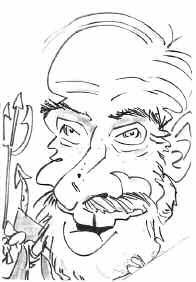
The Prophet is not the only one to
be caricatured – when the
President recently spoke this is
how one listener saw him… with
a devil’s trident! (source: NSS Annual Report 2006)

The NSS is opposed to Faith Schools. School entry criteria based on religion must be reduced and eventually eliminated. 16 year olds students now (as parents already have) have the right to opt of out Religious Education lessons.

The NSS advocates that ALL weddings be Civil weddings but that in addition a separate ceremony could include religious or humanist content.

The NSS publishes The Bulletin three times a year.

The "non belief in the supernatural" is an issue that a minority of NSS members want to exclude from the NSS "constitution". This was not discussed further at this meeting but is clearly a crucial issue for NSS.
It is unlikely that NSS & BHA will merge. This proposal has been rejected by both organisations in the past.

Securalist of the Year
Professor Steve Jones, the scientist & geneticist, has recently been giving a lecture around the country entitled “Why evolution is right and creationism is wrong.” He was awarded the "Secularist of the Year" prize in October 2006 by NSS. I note that Jones has offended some Christians with his allegations that Creationism is "anti-science". This brings him into direct opposition with proponents of Creationism like Ken Ham (who Jones publicly criticised) who argue that evolution is hypothesis, not science. Jones suggested in a BBC Radio Ulster interview on 19 March 2006 that Creationists should be disallowed from being medical doctors because "all of its (Creationism's) claims fly in the face of the whole of science", and disputes the claim that anyone who believes in Biblical Creation can be a serious biologist.

Cobell mentioned that Dorset Humanists could consider affiliating to the NSS just as they were affiliated to British Humanists.
I note that South Hampshire Humanists affiliate to both groups.


Questions from the Floor
Chris Street asked Cobell "Was not the ongoing Evolution v Creationism Scientifhc debate important and what was the NSS view of Science in relation to Religion? Chris stated that he believed that Science (in the words of Lewis Wolpert) is the Best Way of Understanding the World.

?? Asked: What were the differances between NSS and BHA. Cobell said the NSS focuses on challenging religious privaleges and promoting the separation of Church & State whilst BHA focuses on officiation at Humanist Ceremonies (Namings, Weddings and Deaths). The NSS has 2500 members and BHA 5000 members. Membership of both groups has grown significantly recently.

From the
National Secular Society website

(this section needs editing)

We want a society in which all are free to practise their faith, change it or not have one, according to their conscience. Our belief or lack of it should neither advantage or disadvantage. Religion should be a matter of private conscience, for the home and place of worship; it must not have privileged input into the political arena where history shows it to bring conflict and injustice.

The National Secular Society is the leading pressure group defending the rights of non-believers from the demands of religious power-seekers. We campaign on a wide range of issues, including religious influence in the government, the disestablishment of the Church of England, the removal of the Bench of Bishops from the House of Lords and for conversion of religious schools (paid for by the taxpayer) to community schools, open to all.

Additionally:

  1. We fight to protect free expression from attacks by religious groups, often keen to restrict comment about, and examination of, their activities.
  2. We want the blasphemy law to be abolished and artistic expression to be protected from religious censors.
  3. We lobby the BBC to reduce the amount religious propaganda paid for by license-payers, very few of whom are interested.
  4. We want to ensure that human rights always come before religious rights, and to fight the massive exemptions religious bodies are granted from discrimination laws that everyone else has to observe. The NSS was prominent in the campaign to frustrate religious bodies’ attempts to opt out of the Human Rights Act – we fought to limit exemptions in the employment discrimination legislation and other equality law.

Even now the government seems anxious to increase religious involvement in public life. Each increase disadvantages those who have no religion.

Only by secularising our institutions can we ensure that no religious ideology can dominate and discriminate against others.

The NSS was founded in 1866 by Charles Bradlaugh. A message from Claire Rayner.

General Principles
  • Secularism affirms that this life is the only one of which we have any knowledge and human effort should be directed wholly towards its improvement.
  • Affirming that morality is social in origin and application, Secularism aims at promoting the happiness and well-being of mankind. Secularism demands the complete separation of Church and State and the abolition of all privileges granted to religious organisations.
  • Secularism affirms that progress is possible only on the basis of equal freedom of speech and publication; that the free criticism of institutions and ideas is essential to a civilised state.
  • It asserts that supernaturalism is based upon ignorance and assails it as the historic enemy of progress.
  • It seeks to spread education, to promote the fraternity of all peoples as a means of advancing universal peace to further common cultural interests and to develop the freedom and dignity of mankind.
  • To remove an impediment to these objectives, we demand the complete separation of Church and State and the abolition of all privileges granted to religious organisations.

Those of us who value reason are becoming alarmed about the increasingly extreme religious influence in our government, our lawmakers, and our public institutions - especially in our education system. Many people, while standing up for freedom of religion, and freedom not to believe, feel that the proper place for religion is in the place of worship or home. They see the danger of religion becoming too politically ambitious.

The NSS is a rallying point for opposition to this religious resurgence. We must convince our politicians and public servants - as well as our friends, neighbours and colleagues - that our institutions and public life should be secular. A secular state should guarantee freedom of conscience, but eliminate religious privilege.

The only way to prevent the kind of religious power-seeking that leads to conflict is to make both religious discrimination and religious privilege constitutionally impossible.

We need a secular constitution that will:

  • End the privileged input of religious bodies to policy making and law-making
  • Keep all public services free from religious control so that that they remain equally available to all on the same terms
  • Abolish the established church and all its privileges (including 26 bishops in the House of Lords)
  • Put an end to the divisiveness of publicly funded religious schools by making them open to all without discrimination on grounds of religion, or lack of it, and bringing them under local authority controll
  • Abolish blasphemy and similar repressive laws, rather than extend them

Religious influence in Government has not been higher in living memory. The rise of fundamentalist religion of all shades has the potential to seriously erode hard-won freedoms.